

The 10-Year Just Crossed 4.9%, and the Housing Market Is Feeling It Before the Fed Even Moves
Existing home sales fell again in August as mortgage rates track a bond market that's stopped believing rate cuts are coming — and started pricing in the opposite
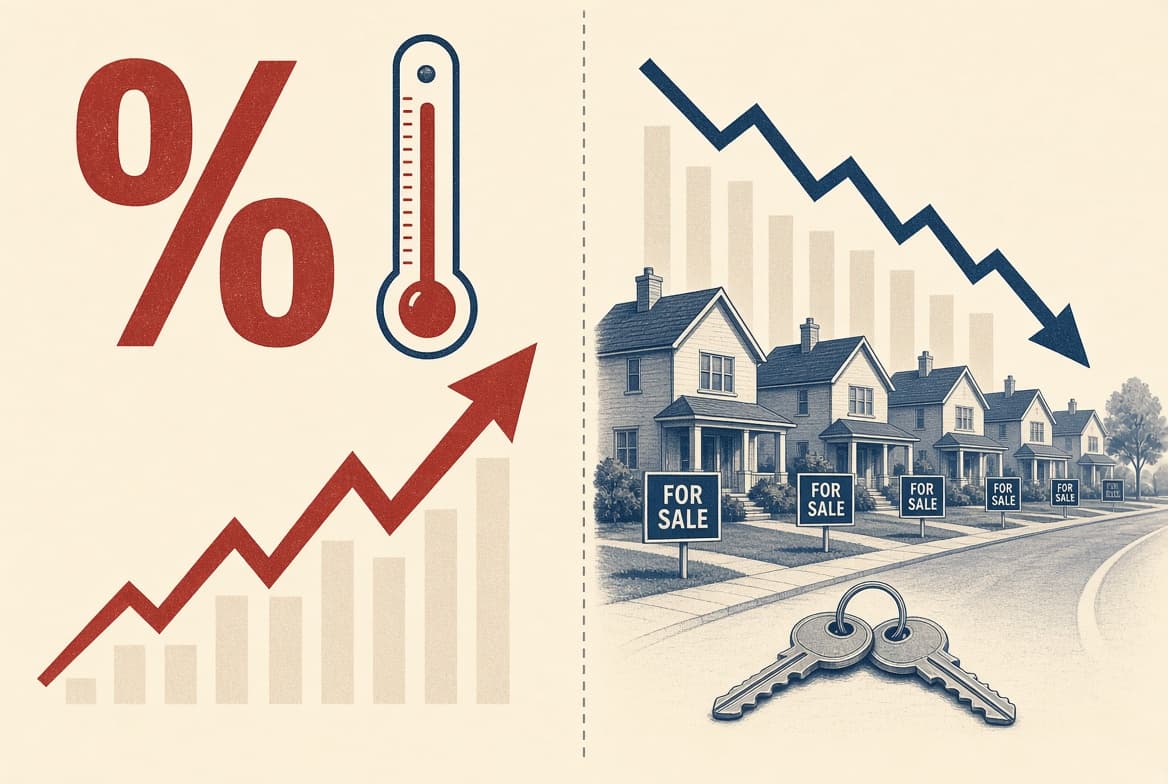
Somewhere in the last two weeks, the conversation around interest rates flipped upside down. For most of this year, the debate was about when the Federal Reserve would start cutting. Now the 10-year Treasury yield is sitting above 4.9% — a level unseen since November 2023 — and it got there for a very unglamorous reason: the bond market no longer believes inflation is behaved enough to let the Fed ease up, and is starting to price real odds of a hike instead.
The mechanics matter here more than the politics. Mortgage rates don't take their cue directly from whatever the Fed's overnight rate happens to be — they track the 10-year yield, because that's the maturity that roughly matches how long people actually keep a mortgage. When the 10-year moves up nearly a full percentage point, as it has since the latest escalation in the Middle East, mortgage rates follow within weeks. For Long Island buyers already contending with some of the highest home prices in the country, that's the difference between a monthly payment that's merely painful and one that's simply out of reach.
The data released this week confirms what that would predict. Existing home sales fell another 2% in August to just under 4 million, with single-family sales leading the decline. The one silver lining — and it's a thin one — is that single-family inventory is finally climbing, up more than 6% year over year, the fastest pace since February. More homes sitting on the market usually means sellers eventually blink on price. Median price growth has in fact decelerated to under 2% annually, a real cooldown from the pace of the last few years. But a frozen market isn't the same thing as an affordable one. Buyers who need a mortgage are simply opting out, and sellers who don't need to move are doing the same. The transaction count shrinks even as list prices barely budge.
What's driving the Treasury market's sudden case of nerves is a tangle of forces feeding on each other. Oil above $100 a barrel is pushing up headline inflation readings directly. The Treasury's own announcement that it would boost long-term bond buybacks landed with less "shock and awe" than investors wanted, meaning less official demand to soak up the flood of new government debt hitting the market. And a growing chorus on trading desks now openly worries that fiscal largesse — including a floated $5,000 election-year payment to households — will keep pumping money into an economy that's already running hotter than its long-run speed limit allows without reigniting inflation.
There's a structural piece too that gets less attention than the headlines about oil and war. The economy's underlying growth rate, driven by productivity, is generally estimated around 2%. Real GDP has been running well above that, propped up by both resilient consumer spending and an enormous wave of AI-related capital investment that shows no sign of slowing. When an economy grows faster than its productive capacity allows, something eventually has to give — usually inflation, sometimes both inflation and growth. Increasingly, the economists watching this most closely think the adjustment will have to come from the consumer, since the AI buildout isn't going anywhere. That's a notable shift from a few months ago, when it was assumed the Fed would simply cut rates once inflation cooled on its own.
For Suffolk County homeowners and would-be buyers, none of this is abstract. A jump in the 10-year yield of the size we've seen translates fairly directly into a jump in the 30-year fixed mortgage rate, and every fraction of a point matters when the median home price on the Island is already stretching what a typical local income can support. Higher borrowing costs also ripple into home equity lines, auto loans, and credit cards — squeezing exactly the households that are already most price-sensitive. If the bond market keeps behaving like it expects tighter policy rather than looser, this isn't a story that resolves itself quickly. It resolves when either inflation clearly breaks lower, or the economy itself slows enough to take the pressure off — and right now, neither has happened yet.
You Might Also Be Interested In

U.S. Crude Settles Above $100 as Brent Reaches Its Highest Close Since April

CoreWeave's Falling Stock Shows Where the AI Buildout's Financing Gets Expensive

Washington Eased Up on Russian Energy. Oil Rose Anyway.