

Washington Eased Up on Russian Energy. Oil Rose Anyway.
Crude topped $100 for the first time since September in a week that opened with a Russian diesel license and ended with a sanctions waiver. The law had already treated oil more harshly than gas.
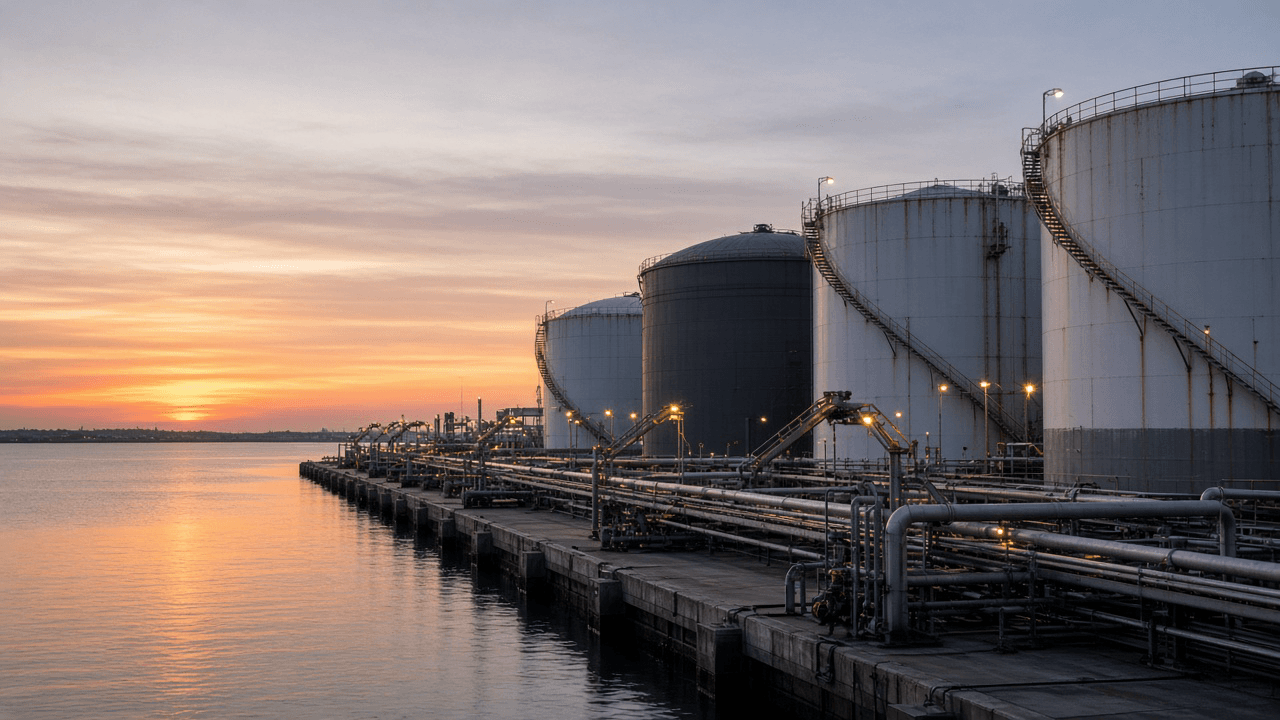
Washington spent the past week loosening its grip on Russian energy, and the price of oil went the other way.
U.S. crude for November delivery settled at $101.41 a barrel on Friday, Oct. 16, up from $91.85 a week earlier, a gain of about 10 percent. It was the first close above $100 since Sept. 18. Brent, the international benchmark, closed at $109.86, up about 5 percent on the week and its highest settlement since May. Both jumped more than 3 percent on Friday alone, and both settled before the White House posted the president's sanctions order that evening, so Friday's move was not a reaction to it.
The two policy moves were aimed at different things. On Oct. 9, the Treasury Department's Office of Foreign Assets Control issued General License 135, authorizing transactions "related to the sale, delivery, offloading, or importation, including importation into the United States, of diesel fuel of Russian Federation origin" through April 7, 2027. The president said that day that Russia would immediately supply more than 300,000 metric tons of diesel, followed by 500,000 tons in November and 1 million tons after that. At standard conversion rates, 300,000 tons of diesel is roughly 2.2 million barrels.
Then, on Oct. 16, the president waived the sanctions and tariffs in the Lindsey O. Graham Sanctioning Russia and Iran Act, two days before they were due to start. The most market-relevant piece was a threatened 100 percent tariff on goods from the five largest buyers of Russian crude oil or natural gas, which the order formally set and then switched off.
The statute itself already treated oil and gas differently. Section 113 exempts a country's natural gas purchases from the tariff if its imports of Russian gas were less than 15 percent of Russia's total gas exports and it has taken significant steps to cut them. There is no comparable carve-out for crude. Congress aimed the law's sharpest instrument at oil.
That distinction matters for anyone trying to read the price board. If traders believed the threat to Russia's crude buyers was going to cut supply, lifting it should have pushed oil down. Crude rose instead, which suggests the market was not pricing the Graham Act's tariffs as likely to bite in the first place, and that it is trading on something else.
The products tell the same story from the other side. Gasoline futures fell about 1.8 percent on the week to $3.24 a gallon, while New York Harbor diesel futures rose about 3.4 percent to $4.90. The license covers diesel, and diesel did not get cheaper. Natural gas futures fell about 3 percent to $3.12 per million British thermal units.
At the pump, the relief has been small. The Energy Information Administration's weekly survey put the national average for regular gasoline at $4.331 a gallon on Oct. 12, down 2.3 cents from the week before but $1.27 higher than a year earlier. In New York City it was $4.314. Diesel averaged $6.179 nationally, down 2 cents on the week and $2.514 above a year ago, and $6.471 across the Central Atlantic region that includes New York.
Those survey prices predate the late-week jump in crude. The next readings come Tuesday, Oct. 20.
The diesel license also carries a limit. It does not authorize any debit to U.S. accounts of Russia's central bank, its National Wealth Fund or its Finance Ministry.
None of this means the sanctions decisions are irrelevant to markets. It means their effect runs through a different channel than a gas-pump headline implies. A U.S. tariff threat on the biggest buyers of Russian crude was a supply risk for the world's largest oil trade. Waiving it removes a tail risk rather than adding barrels, and a diesel license measured in a few million barrels is small next to that.
For a Long Island household, the number to watch this winter is the futures price of heating oil, not the sanctions announcements.
You Might Also Be Interested In

CoreWeave's Falling Stock Shows Where the AI Buildout's Financing Gets Expensive

Amazon's Cloud Boss Just Said Computing Power Is Sold Out Through 2028

Labor Department Suspends Microsoft, Adobe and Six Outsourcing Firms From Green-Card Labor Program