

Brookhaven Board Meeting Gets Heated, Approves Data Center Moratorium
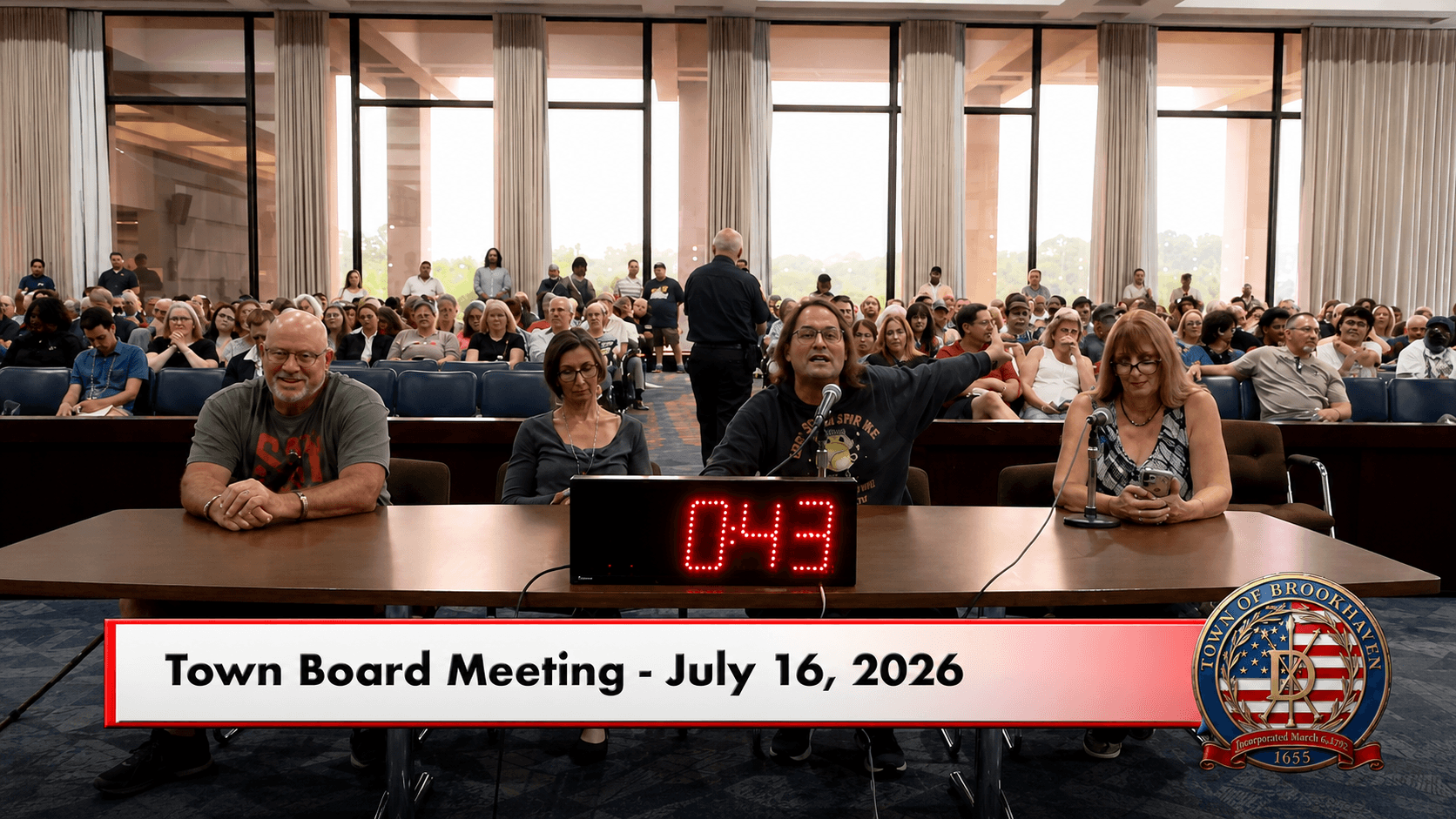
A packed auditorium of residents urged Brookhaven Town officials to keep data centers out of the community, warning the massive facilities could strain Long Island’s electric grid, increase utility costs, threaten the region’s sole-source aquifer and reduce residents’ quality of life.
Following testimony that was overwhelmingly opposed, the town board unanimously approved an 18-month moratorium on new data center applications. The temporary ban will allow officials to draft Brookhaven’s first zoning regulations governing where the facilities could be built and how they would operate.
“We are very concerned about the impact of large data centers on our energy grid,” resident Jordan Christiansen said during the July 16 public hearing. “We risk brownouts and blackouts. We can’t do this without having a plan.”
Michael Mannix of Coram urged officials to balance economic development with environmental protection.
“Protecting our environment and quality of life are just as important as economic growth,” Mannix said. “Data centers will require a great deal of electricity and push our costs even higher.”
Richard Perez said he supports technological innovation but not if residents bear the burden.
“I want to see development of technology, but not at the expense of people, their resources and their infrastructure,” Perez said.
Former Stony Brook University employee Ben Hogan described working around high-performance computing equipment.
“Industrial-strength earplugs didn’t even help,” he testified.
Several residents also questioned whether industrial buildings under construction along the Long Island Expressway in Yaphank and elsewhere could eventually become data centers.
Supervisor Dan Panico said those projects are located in long-established industrial zones and cautioned residents against assuming every warehouse is intended for data center use.
“If you see a warehouse going up, it is wrong to assume it’s a data center,” Panico said, noting Brookhaven currently has no zoning code specifically for data centers and that many projects are legitimate trucking or distribution facilities.
Addressing concerns about potential lawsuits, Panico said no applications are currently pending and the Brookhaven Industrial Development Agency will not consider data center proposals during the moratorium.
“We are running down all the false rumors on social media,” he said. “This town doesn’t capitulate.”
Panico also acknowledged Long Island’s energy challenges.
“The chance of brownouts is real,” he said, adding that the state needs a more realistic discussion about future power generation.
He said the moratorium gives the Department of Planning, Environment and Land Management time to develop zoning rules addressing energy and water consumption, noise, environmental impacts, public safety and infrastructure capacity while protecting Brookhaven’s natural resources.
Councilman Jonathan Kornreich said officials considered including cryptocurrency mining operations in the moratorium but determined such projects are unlikely on Long Island because of high electricity costs.
Offering a different perspective, Tatiana Lasalle of the Long Island Association urged the board not to adopt what she described as a blanket moratorium that could discourage investment.
She said data centers support artificial intelligence, cloud computing, life sciences and advanced manufacturing while generating tax revenue. She also said newer facilities can incorporate technology that reduces impacts on water supplies and the electric grid.
The Long Island Association also opposes the state’s proposed 12-month moratorium, arguing New York risks losing investment and high-paying jobs to neighboring states.
Assemblyman Joseph DeStefano, who opposed the statewide proposal, distinguished Albany’s approach from Brookhaven’s local review.
“The issue comes down to two fundamental principles: local control and economic opportunity,” DeStefano said.
“If Brookhaven wants to study the issue and consider its own 18-month moratorium, that’s the town’s right,” he said. “Local officials, working with local residents, should make those decisions—not Gov. Hochul and the State Legislature.”
Panico said the town will use the moratorium to gather public input and develop a comprehensive zoning framework before considering any future data center proposals.
You Might Also Be Interested In

Democrat Chief’s Deals Under Investigation

Legendary CIA Operative Coming to Long Island

Veterans Bench Honors Masonic Leader in Manorville