El Salvador Expands Classroom AI Tutors After Pilot Scores Rise; New York Restricts Student Use
Political Polling and Teacher Unions Play Major Role
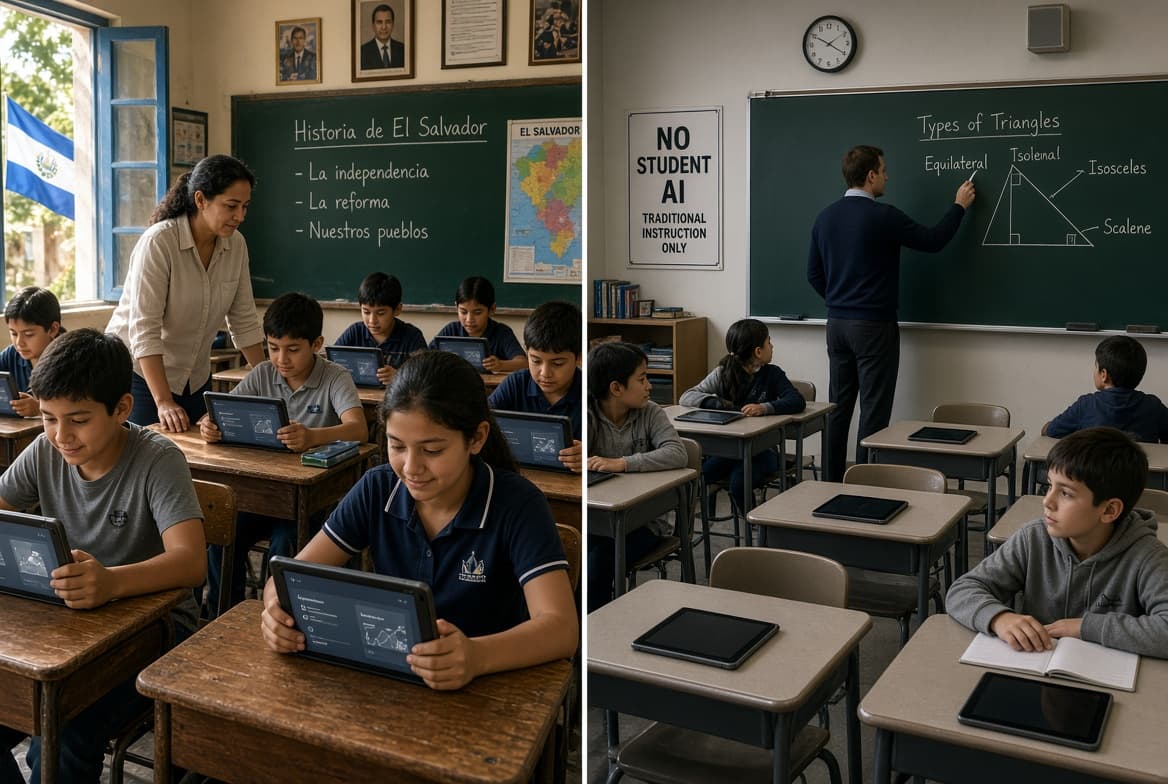
El Salvador is rapidly expanding artificial-intelligence tutoring in public schools after a limited pilot produced scores well above the country’s usual performance, even as New York City imposed one of the strictest limits on student-facing generative AI in the United States.
President Nayib Bukele said Sept. 5 that 1,198 volunteer students at 171 public schools using AI tutors scored above El Salvador’s national average on a June PISA for Schools assessment and posted results comparable to Germany’s and Sweden’s 2022 PISA country averages in reading, math and science. The World Bank called the findings “surprising and very encouraging” but stressed the sample was not nationally representative and that PISA for Schools is a diagnostic tool, not the full national PISA cycle. El Salvador’s 2022 national PISA scores were among the lowest in the OECD comparison set, making the results of this AI pilot both surprising and encouraging.
The El Salvador government and xAI announced in December 2025 what they described as the first nationwide public-school AI tutoring program. Officials said they would build school-specific software powered by Grok, aligned to the national curriculum from first grade through bachillerato, covering more than 5,000 public schools and more than 1 million students over about two years. Teachers were to act as “collaborative partners” with the technology. By early September 2026 Bukele said tutors were already in more than 1,000 schools, with full coverage projected in about 18 months. The effort sits inside the AprendES modernization program; the World Bank approved $501 million in March 2026 for 2026–2031 work that includes Grok as a learning tool.
Salvadoran teachers’ unions have not mounted a campaign against Grok itself, but have voiced concerns about what this technology might mean for their members. ANDES 21 de Junio offered courses on classroom AI for their teachers. Other groups, including SIMEDUCO, questioned whether students used devices for study or play and tied the digital push to unresolved pay and working-condition disputes. Unions say Article 33 of their charter requires a salary review at least every three years and that the last meaningful adjustment was a 2019 $100 public-sector raise. They report position eliminations, accelerated retirements, and strained teacher health coverage as separate concerns. Bukele has continued the AI rollout alongside school construction, devices and a pledged rise toward 8 percent of GDP for education. This move mirrors much of Bukele's broader orientation toward ignoring public polling and implementing what he believes what is likely to best serve the average, working class El Salvadorian, with education being a cornerstone of this initiative.
In the United States, the American Federation of Teachers in May 2026 released a “Devices Down, Eyes Up, Hands-On” 10-point plan calling for no screens in pre-K–2 except for special needs, no student-facing AI in elementary school, and a ban on social companion chatbots until at least age 16. AFT President Randi Weingarten said she was not calling for “an AI ban or a Chromebook bonfire.” The AFT and New York City’s United Federation of Teachers also launched teacher-training programs with Microsoft, OpenAI and Anthropic. New York State United Teachers passed a June 2026 resolution tracking much of the AFT line.
On Sept. 2, New York City Mayor Zohran Mamdani and Chancellor Kamar Samuels announced a one-year moratorium on student-facing generative AI for K through eighth grade, affecting about 600,000 students. Companion chatbots were banned in all grades. High school use was limited to literacy modules and small supervised pilots; teachers may use AI for planning but not grading. Officials said AI features on about 38 existing products would be disabled. Weingarten said the policy was “very similar” to what the AFT proposed. UFT President Michael Mulgrew praised screen-time limits but criticized the city for leaving schools to determine which purchased products still contain AI.
It is important to note that prominent New York City private schools, often attended by the wealthiest New Yorker's but lacking the influence of state and city policy, or the teachers union, are all implementing various versions of the El Salvador technology, encouraging teachers and students to incorporate AI into their curriculums and learning programs. They have publicly acknowledged the risks associated with AI, but have largely sided with the idea that the risk of children being left behind by peers using the new technology outweighs the risk of using it.
Education officials in El Salvador present the AI tutors as a way to give working-class students individualized help at scale - a dynamic often reserved for wealthy private schools. Public schools in America might look to AI as a means to level the playing field with elite private schools who possess greater resources, just as El Salvador has done. Supporters of the New York rules say young children need human instruction first and that industry-sponsored research has not settled safety and developmental questions.
Once again the government and their union backers insist on prudence when doing so helps them and harms the people.
You Might Also Be Interested In

Suffolk's Newest Fire Investigator Has A Nose For Arson
Pat-Med Students Turn Civic Lessons Into Action
DeStefano Delivers $1.9 Million for Safer Streets