
Prediction Markets Score Big in Midterms
Online election bettors correctly called Long Island’s congressional races, the governor’s contest and control of Congress.
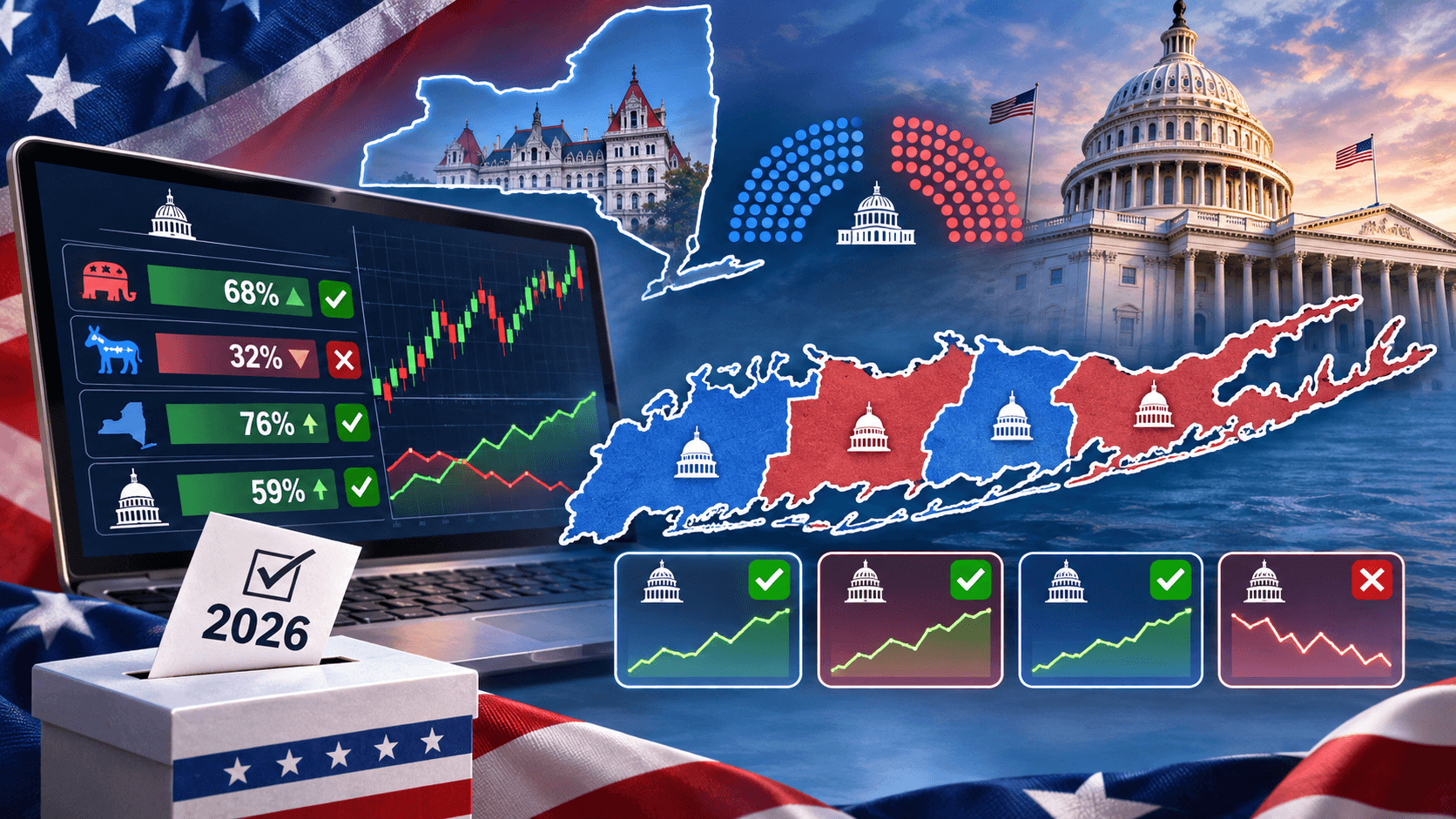
Long Island’s four congressional races and New York’s governor’s contest unfolded as prediction markets anticipated, while traders correctly forecast a Democratic takeover of Congress. But several unexpected victories exposed the limits of betting on election outcomes.
Online platforms Kalshi and Polymarket allow individuals to buy contracts predicting political results, effectively putting money behind their opinions rather than simply responding to traditional polls.
On Long Island, Kalshi gave Republican Rep. Nick LaLota an 81.5% chance of retaining the First Congressional District and Republican Rep. Andrew Garbarino an 82.5% chance in the Second District. Both won.
Democratic Rep. Tom Suozzi was assigned a 93.3% probability of victory in the Third District, while Democrat Laura Gillen had a 95% chance of winning the Fourth. Both prevailed.
In the governor’s race, incumbent Democrat Kathy Hochul was an overwhelming favorite, with a 96% chance of defeating Republican Bruce Blakeman. Hochul won with approximately 60% of the vote.
Nationally, traders correctly anticipated Democrats taking control of both houses of Congress. On Election Day, Kalshi priced Democratic House control at 93% and Senate control at 72%.
However, the markets produced some substantial misses.
In Mississippi’s Senate race, Democrat Scott Colom defeated Republican incumbent Cindy Hyde-Smith despite receiving only a 13% chance of victory on Kalshi. Colom became the first Democrat elected to the Senate from Mississippi since 1982 and the state’s first Black senator since Reconstruction.
Democrats also won North Carolina’s Sixth Congressional District despite an estimated 14% probability.
South Carolina Democrat Annie Andrews defeated her Republican opponent despite prediction markets assigning her approximately a 30% chance of victory in a race that became part of the blue tsunami sweeping Democrats into office nationwide.
The financial stakes were enormous.
Kalshi reported approximately $2.5 billion in total election-related trading volume, including $716 million on Election Day. An independent analysis using a narrower selection of midterm contracts recorded $2 billion combined across Kalshi and Polymarket.
Those figures represent transaction volume, not necessarily unique dollars wagered, because contracts can change hands repeatedly.
The results demonstrate how financially motivated crowds can anticipate election outcomes while occasionally getting some contests dramatically wrong.
You Might Also Be Interested In

March for Liberty Caps America’s 250th Celebration

Shoreham Land Deal Raises Taxpayer Concerns

Bohemia Artist Revives Tribute to Vietnam Veterans