
After Last Week's Outages, Officials Still Owe the Public a Full Accounting
Officials blame routine maintenance that has gone on for decades, and their account of why it ran on a Friday afternoon in the name of safety does not add up. The public is owed written answers.
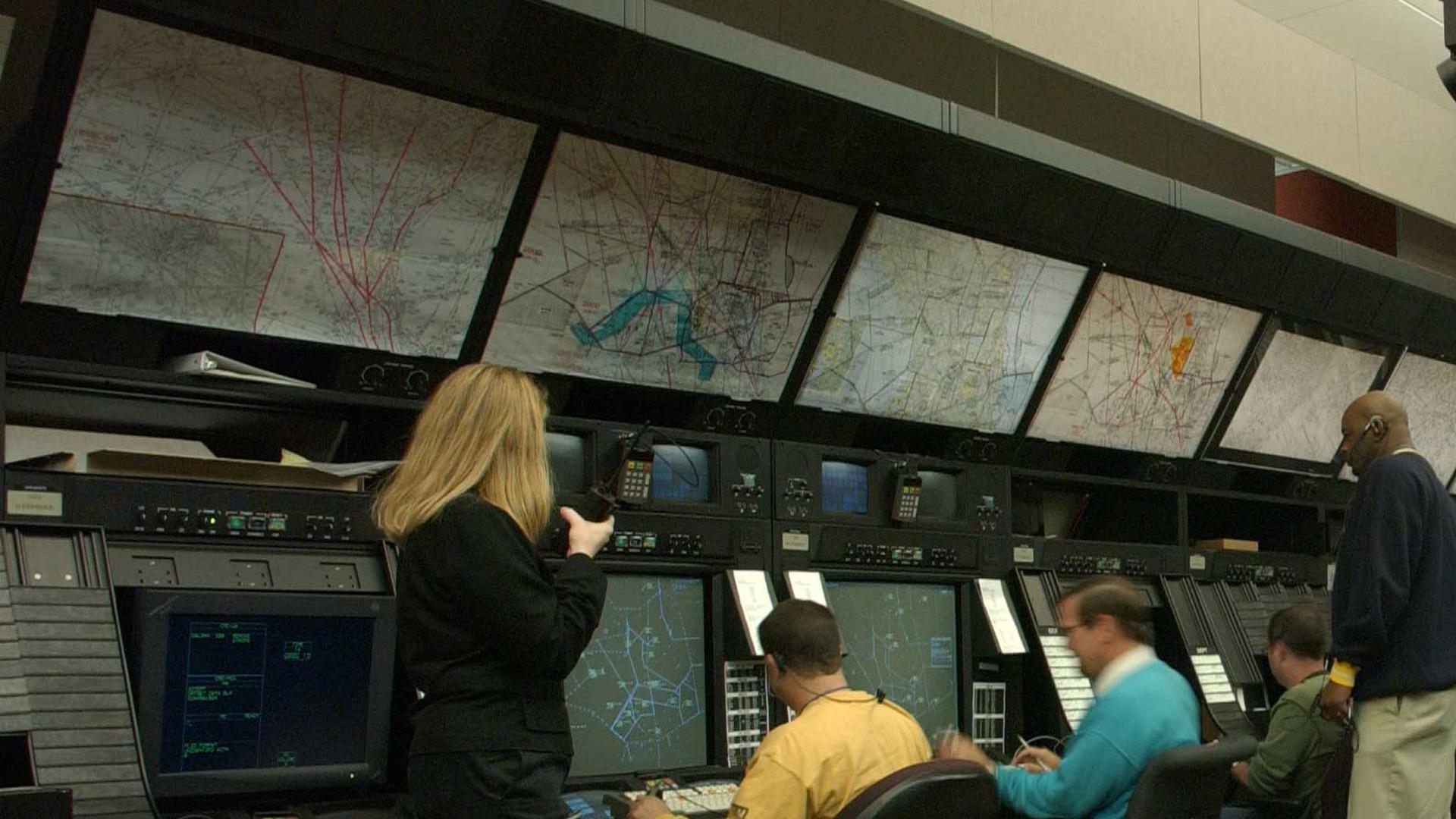
Late last week, two networks that millions of Americans count on every working day failed in succession. Microsoft's cloud email and collaboration services began failing at 11:20 a.m. Eastern on Thursday, Nov. 12, and the company's preliminary incident report marks the end of active impact at 11:10 a.m. Friday, an outage of roughly 24 hours. About four hours and 20 minutes later, the Federal Aviation Administration's communications backbone started to fail. Trouble began around 3:30 p.m. At approximately 4 p.m., just as the stock markets closed, the agency halted flights nationwide. Its command center signed the ground-stop order at 3:54 p.m. and lifted it at 8:15 p.m.
Both owners have described the failures as the product of ordinary upgrade work. Microsoft blames a latent defect in a change it made to its network gateway servers in July, which surfaced after Teams traffic was shifted onto the primary gateway and nearly 14 percent of that gateway's server capacity was offline. The company called the episode "a technical issue not related to cyber or AI / agents" and said it had "no indication this is the result of malicious or cyber activity."
The FAA says its legacy time-division network became unstable after a flood of about a thousand connection attempts, several seconds apart, and that a contractor, L3Harris, had been installing a new router at a remote radio site in El Dorado, Ark. An Amarillo, Texas, radar facility, where similar work had been finished weeks earlier, is also under review. The disturbance reached 17 of the agency's 22 en route centers. The agency says the new modernization equipment held, and that none of the towers already upgraded with the congressional down payment went down. It says it has "no indication that this was a cyberattack or an outside nefarious actor." The root cause, the FAA says, is still under investigation.
The government's own explanation of the Arkansas job does not hold together. At a Saturday press conference with FAA Administrator Bryan Bedford, Transportation Secretary Sean Duffy described the Arkansas job as a contractor "doing routine maintenance" to move old copper lines onto fiber. "This work has been happening in America for decades," he said, adding, "this is not complicated. It's pretty straightforward work." Bedford called the router swaps "ordinary course-of-business stuff" on what he described as "the existing 1980's TDMI telco network."
A reporter then asked why the upgrade was made at 3 p.m. on a Friday instead of at midnight on a Saturday. Duffy called it "a great question" and answered that "safety is paramount," that without the upgrades "we have a less safe system," and that "we can't continue on technology of the eighties." Because the job was at a remote location, he said, "we'll do those during the day," while switchovers at big facilities such as Newark "happen at night." He promised "a reevaluation of when we do this work."
That answer makes no sense. Work that has been routine for decades offers no reason to schedule it for a weekday afternoon, and Duffy's own account says large sites are switched at night because a failure there would do more harm. Invoking safety to explain the timing runs against what happened next. The job set off a data flood that reached 17 of 22 en route centers and grounded flights nationwide at about 4 p.m., just as the markets closed, on a Friday heading into the weekend. Each owner also said it saw no attack while its own review was still under way. On Sunday, Duffy said the two routers from Arkansas and Texas are being tested at L3Harris headquarters in Florida, with the FBI offering support.
A day earlier, at a Friday night White House briefing, Homeland Security Secretary Markwayne Mullin opened by declaring "there is no connection between this and Microsoft," then added, "I know a lot of people are making that jump." Pressed on whether an attack could be excluded, he answered, "there's nothing completely certain right now." Duffy, standing with him, said, "I don't want to rule out that we didn't have nefarious activity here." Mullin also called the aging control system "a national security risk." Asked whether Iranian elements might be plotting, he said, "we're not seeing that at all."
On Saturday, a report in Israel citing senior Israeli and American officials said Israeli intelligence had warned the CIA of an Iranian plan for drone attacks targeting President Trump and senior administration officials, and that the warning prompted heightened security in Washington, where some senior American officials were moved to protected facilities. No American official has confirmed that report, and the White House and the CIA have not addressed it publicly. Officials should say plainly whether the warning was real and what they have done about it.
Related or unrelated, officials should explain whether clearing the US sky of commercial aircraft would or would not be a useful measure to defend against imminent drone strikes.
Some say never let a crisis go to waste, and Duffy offered several funding figures he claimed could help solve the FAA problem. The funding figures still differ. On Friday, Duffy said, "I've asked, the president has asked for $30 billion. I want $50 billion." The FAA's own fact sheet still calls the $12.5 billion Congress already provided a down payment and lists $20 billion more as the remaining need. When the secretary wants $50 billion and the agency's paperwork says $20 billion more, taxpayers are entitled to an itemized bill.
Officials owe specific answers, in writing. Microsoft should state whether its final report finds any outside traffic in the surge and whether it has shared its data with federal cyber officials. The FAA and L3Harris should explain why a router at Amarillo, installed weeks earlier, began misbehaving the same afternoon as the new work in Arkansas. Gov. Kathy Hochul has called on Congress to "launch a full investigation," and on that point she is right. Mullin sits before the House Homeland Security Committee, chaired by Long Island's Rep. Andrew Garbarino, on Wednesday at 10 a.m. Members should press him on what was known Friday night, on whether the reported Iranian drone threat has any basis, on the state of the two routers, on why routine work was scheduled for a Friday afternoon, and on whether the reviews are complete.
None of this proves coordination, and nobody with access to the logs has claimed any. The record already shows an official explanation that contradicts itself, in which decades-old routine work was run on a Friday afternoon in the name of safety and ended in a nationwide ground stop. Microsoft's final incident report is still outstanding, and the FAA says its root-cause work continues. Wednesday's hearing and those pending reviews give Microsoft, the FAA and the Department of Homeland Security the chance to put their answers on the record in writing.
You Might Also Be Interested In

Are You Ready for the Next Chokepoint Crisis? Houthis Shutting Down Mandeb Strait
Flight Disruptions Enter Third Day as Duffy Demands Billions
SpaceX Catches Starship Upper Stage in Texas Return