

Carrier-short Navy struggles with its missions as deployments take their toll
The chief vulnerability of having a small Navy is that it makes the rotation of ships for resupply, maintenance or liberty ports extremely difficult.
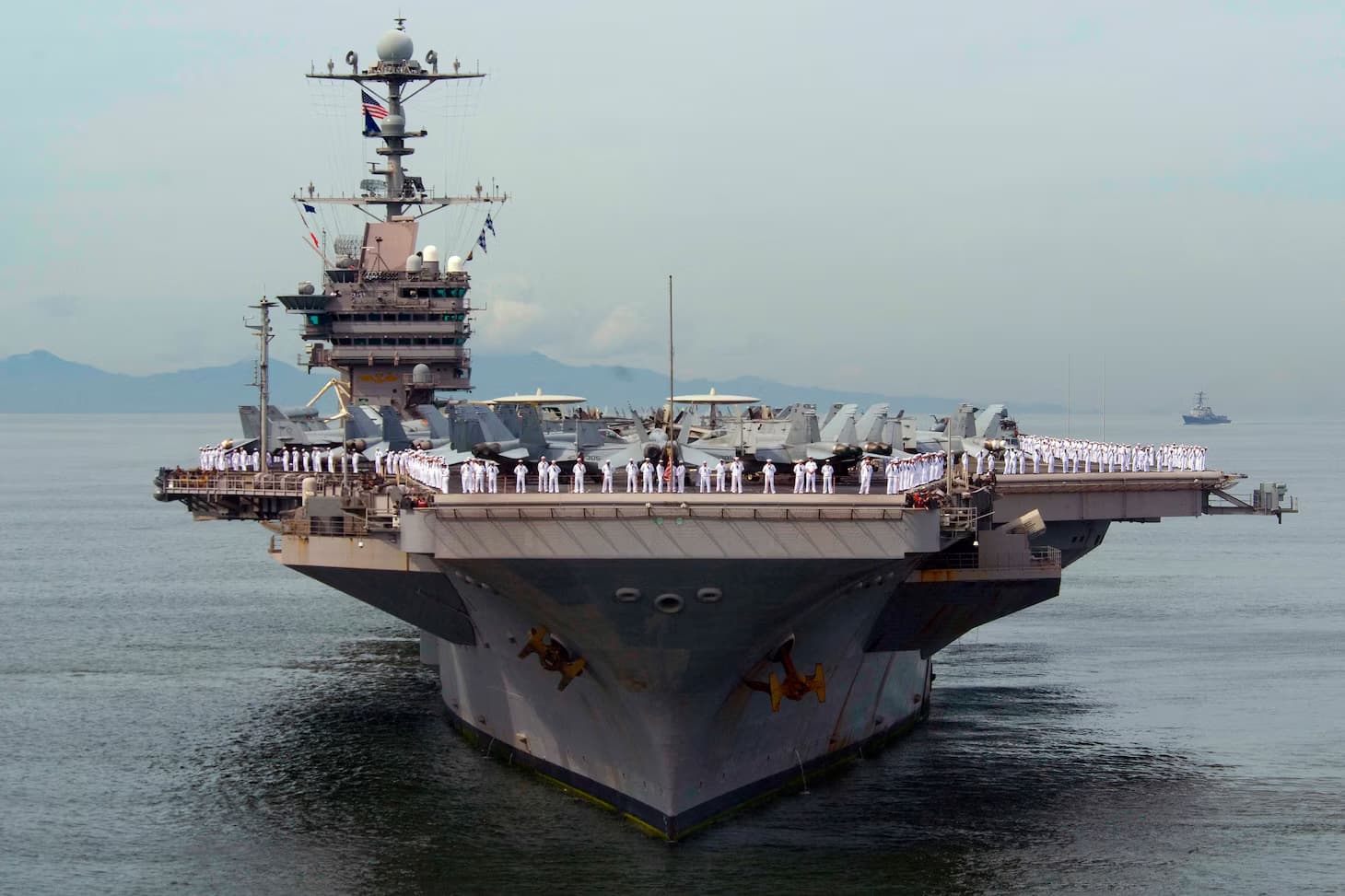
The chief vulnerability of having a small Navy is that it makes the rotation of ships for resupply, maintenance or liberty ports extremely difficult.
This is the reason the Navy’s 11-carrier inventory struggles to keep four carriers deployed at any one time.
Of our 11 carriers, three are deployed, two to the Iranian theater, USS George Washington and USS George H.W. Bush, and one to the Western Pacific, USS Theodore Roosevelt.
By law, the Navy must field at least 11 carriers, but USS Chester W. Nimitz is a paper carrier kept on the books for appearances–a charade that ends when USS John F. Kennedy completes sea trials, commissions and goes through its certification process.
The new carrier made its first F-35C arrested Oct. 13, but the Navy is not expected to accept formal delivery of JFK until March at the earliest.
USS Dwight D. Eisenhower was in training exercises to prepare for deployment off the Virginia coast Sept. 28, when the arresting gear failed to stop a landing Growler fighter jet. Four flight deck sailors were injured and the two pilots were pulled out of the drink.
Ike returned to Norfolk and its flight operations were suspended.
There is speculation that Roosevelt is slated to replace Bush, whose crew made a Phuket, Thailand, liberty call, before returning on station in the Arabian Sea, which means that Roosevelt brings with her its collection of Seahawk unmanned surface vessels.
The Seahawks are 135-foot unmanned vessels that function as a carrier group’s eyes-and-ears, specifically looking and listening for submarines.
In addition to our super-carriers, we have nine amphibious assault carriers, which are dedicated to transporting and supporting Marines.
One of those nine, USS Boxer, and its contingent of USS Portland and USS Comstock are still deployed to the Iranian Theater, but its more than 2,000 Marines and nine hovercraft landing vessels never got the call, so they are shipping out soon.
USS Tripoli and its ships and Marines left in July.
Waiting in the wings to replace the Boxer Amphibious Readiness Group, is the USS Makin Island ARG. Makin Island is also a Wasp-class carrier, and she and her contingent of USS John P. Murtha and USS Anchorage are now in port at Yokosuka, Japan.
Like Boxer, Makin Island also is equipped with short-takeoff F-35B’s, tilt-rotor Ospreys, Viper attack and Super Stallion heavy-cargo helicopters.
Our carrier-centric leads us to lose track of the destroyers, frigates and whatever cruisers President Joseph R. Biden Jr.’s “Divest to Invest” farce left us.
In the Red Sea, we have two guided missile destroyers, USS Gonzalez and USS Jason Dunham, which complement our significant forces and infrastructure at Djibouti.
Then, further away, in a mission that was once the province of a full-scale carrier task force through the Taiwan Strait, the humble USS Charleston passed through the Sabina Shoals in the South China Sea on a freedom of navigation mission.
The three-hulled 419-foot trimaran with its 70-man crew made its point Oct. 20 to Red China.
You Might Also Be Interested In
GUEST EDITORIAL: Healthcare Costs Squeeze Main Street. CHOICE Arrangements Can Help.

New Yorkers Can't Afford Four More Years of Kathy Hochul's Spending Spree

Brazil’s Election Is a Five-Alarm Fire for American Conservatives