

My Father Fixed Typewriters. AI Is the Next Revolution.
Students have two choices: boo AI or master it. History suggests only one of those choices ends well.
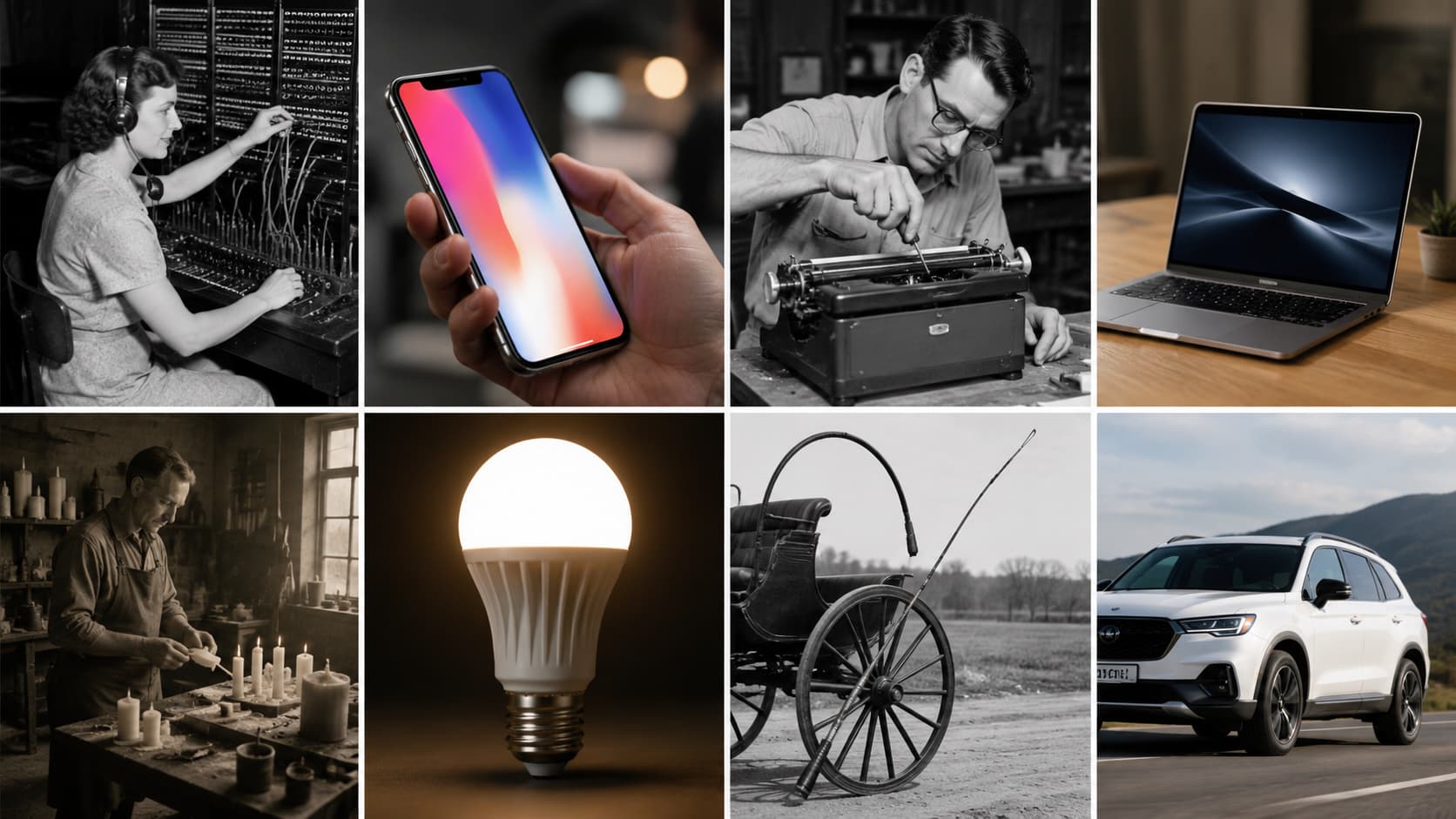
My biological father was a typewriter repairman.
Growing up, our tiny, cramped house sometimes looked more like a repair shop than a home. Typewriters were everywhere. IBMs. Royals. Smith-Coronas. Even the gunmaker Remington made typewriters. Keys, springs, screws, ribbons and mysterious metal parts. Most of his repairs were done on the road in other offices or the "shop" where Town & Country Office and Machines called home. Sometimes repair work was brought home for tough jobs.
Some machines were waiting to be repaired. Others were waiting for parts. It wasn't clutter.
It was how my father put food on our table.
While my childhood was rough and abusive, as a kid, I loved the rare times I went to work with him.
Back in the 1970's "Take Your Son to Work Day" did not exist. The few times he let me tag along was when he was the last resort in the summer where the choice was "take your kid on service calls" or "risk CPS popping over because he was home alone all day."
I didn't realize it then, but I was getting a front-row seat to a world that no longer exists.
Every morning began the same way. He'd stop at the "back house" right behind us where my Baba made him coffee. From my grandmother's kitchen table, my father would spread out a massive Rand McNally road atlas in a thick three-ring binder. Every page was covered with a grid of streets and roads. Beside it sat a stack of paper service calls from businesses scattered across the county.
Before he ever turned the key in the ignition, he had to become his own GPS.
My old man knew every single street, alley, and highway in town, similar to how cabbies in London have to memorize more than 20,000 landmarks and 25,000 streets before getting access to their famous black cabs.
He had to see where he was going to fix typewriters that day, study every address, map the most efficient route by hand, calculate which businesses to visit first and hope traffic didn't derail the day's schedule.
If he made one wrong turn, there wasn't a nice, electronic voice telling him to "recalculate." There was only wasted time, wasted gas, frustrated customers, and a hot tempered Ukrainian who had to crack open the map and start from scratch.
Today, my smartphone performs that same task in less than five seconds.
My father also carried something almost every American under 30 has never used. A small black plastic container filled with tightly rolled quarters. It was the small canisters that you bought rolls of film in.
Not because he collected quarters. Because he needed quick dimes and quarters to make a call at a pay phone.
If he got lost, was running behind schedule or needed to tell a customer he'd be late, he had to find a public pay phone.
During the late 1990s, America had roughly 2.6 million public pay phones. Today, fewer than 100,000 remain, replaced almost entirely by smartphones. That little container of quarters has become as obsolete as the rotary phone itself.
My father never imagined the day would come when every American would carry a GPS, camera, flashlight, calculator, encyclopedia, telephone and map in their pocket. But it did.
That's why I found it astonishing to watch recent college graduates boo and melt down at commencement speakers simply for mentioning Artificial Intelligence (AI).
Former Google CEO Eric Schmidt was jeered while warning graduates that AI would reshape nearly every profession. Similar reactions occurred at other commencement ceremonies across the country as speakers urged students to embrace, not be afraid of, the biggest technological shift since the internet. One I believe even bigger than going from the horse and buggy to a Space X rocket.
I understand why they're nervous. I get it. I saw it firsthand with my old man. Ask yourself: what kind of look would you get from these gender studies grads if you told them your parent was a typewriter repairman?
But they're pointing their frustration in the wrong direction. Booing artificial intelligence won't stop it any more than booing automobiles would have saved the horse-and-buggy industry. The irony is laughable.
For years, colleges warned students not to use AI. No question that decision was fear based. Professors did not want students to cheat.
Then those same college students graduated into a job market where employers increasingly expect applicants to understand it. Universities should have been teaching responsible AI use instead of pretending it could simply be banned. Even here in New York, schools understand what's happening.
In Salamanca, on the other side of the state, school officials recently introduced "Sally," an AI-powered humanoid classroom assistant designed to help students learn coding, robotics and artificial intelligence. Sure, unions are freaking out over who is making the doll (Google it, but not on a work computer). District leaders stressed that no teachers are being replaced. The robot is another educational tool. Predictably, the teachers union objected.
No one at all is suggesting robots replace great teachers. Keep in mind, calculators didn't replace math teachers. Google didn't replace librarians. Computers didn't replace professors. Technology changes tools. It doesn't eliminate the need for talented people, especially people willing to embrace tech for the betterment of mankind.
History proves this over and over again. Take my late father's profession. In 1963, the U.S. Bureau of Labor Statistics estimated approximately 22,000 Americans worked as typewriter repairmen. They serviced the machines that powered virtually every office in America. Today, that occupation has almost entirely disappeared. Not because the workers became less skilled. Because computers and smartphones became better, faster, smaller, and cheaper.
The same thing happened with telephone operators. At their peak during the late 1960s and early 1970s, more than 400,000 Americans worked as switchboard operators, manually connecting calls by plugging cables into massive switchboards. Automation eliminated those jobs. Did communication via telephones disappear? Hardly. I'd argue the exact opposite. We're addicted to them now, more than ever.
The communications revolution created entirely new industries employing millions of Americans in wireless technology, fiber optics, internet infrastructure, software engineering, cybersecurity and satellite communications. The occupation disappeared. The industry exploded.
Photography tells the same story. When I lived overseas I remember having "one shot" for photos in a Kodak still camera I lugged everywhere from France to Austria to Italy.
At its peak, Eastman Kodak based in New York State employed nearly 145,000 people worldwide, including more than 60,000 in Rochester alone. Entire neighborhoods built their lives around photographic film. Then digital cameras arrived. Don't ever forget, it was a Kodak engineer who brought the concept of a digital camera to executives there, and he was basically rebuffed because they believed it would kill the still camera film industry.
Kodak eventually filed for bankruptcy protection, film-processing labs disappeared and nearly every smartphone became a better camera than professional photographers owned just thirty years ago.
Then there were the poor candle makers.
Before electricity, every American depended upon candles, lanterns or oil lamps after sunset. It was an essential occupation. Electricity didn't eliminate work. It created electric utilities, electrical contractors, power plants, electrical engineers, appliance manufacturers and one of the largest industries in human history.
The same is true of good old fashioned buggy whips. Factories once employed workers making buggy whips, harnesses and horse equipment because horses powered America. Thank God Henry Ford changed the world, for the better.
Imagine if government had tried to protect buggy-whip jobs by outlawing automobiles? Imagine banning electric lights to save candle makers? Imagine prohibiting computers because they threatened typewriter repairmen like my father?
It sounds absurd. Because it is. Innovation has always disrupted work, but it has also created better work and better job opportunities for those who embraced the tech transition.
Let me save you the suspense, especially you spoiled, entitled, fear mongering college grads who want to crawl to your safe space because of AI: Artificial intelligence will absolutely eliminate certain jobs. Gone forever, and for the better.
Anyone whining when picking up a soon to be worthless Sanskrit degree isn't paying attention. They're blind.
Routine paperwork, repetitive administrative tasks and many predictable processes will increasingly become automated. AI is already creating entirely new and exciting careers like engineers, machine-learning specialists, AI safety researchers, automation consultants, robot technicians (that school in Salamanca is gonna need those), and AI data scientists.
These jobs that didn't exist just a few years ago.
Of course, we need measured and common sense safeguards against bias, misinformation, privacy violations and intellectual property theft. I want students to be educated, not indoctrinated, on AI.
But regulating technology is not the same as fearing it. Every generation faces this choice, just like my father's did. They adapted to electronic typewriters, fax machines, then computers. My generation adapted to the internet. Keep in mind, the first newsroom I worked in at WSTM in Syracuse in 1993 had typewriters.
Today's graduates must adapt and EMBRACE artificial intelligence. The future isn't asking for their permission. Tech trailblazers don't give a damn if snotty, entitled college kids condemn the spread of AI. It's arriving and taking over no matter what. . When I think back to those days riding alongside my father, watching him unfold that enormous Rand McNally map, carefully plotting service calls by hand before dropping quarters into a pay phone to tell a customer he was running late, I'm reminded just how much the world has changed. None of those tools disappeared because people stopped working. They disappeared because better tools came along.
My father's profession is gone, as harsh as this is, it's as dead as he is.
Not because his work wasn't valuable. It was. I saw that firsthand.
But the technological train did not slam on the brakes and stand still to preserve one occupation. It moved forward at warp speed, faster than those Space X rockets I mentioned before.
Artificial intelligence is the next chapter in that story. Students have two choices: boo it or master it for their benefit.
History suggests only one of those choices ends well.
You Might Also Be Interested In

Three Memorials. One Nation. One Promise: Never Forget
Give Our Kids the Tutor Every Wealthy Child Already Has

The Decision That Matters Most: Why Asset Allocation Drives Everything Else