
Painting the Patriot: Long Island Artist Honors William Floyd
Elaine Faith Ryder-Thompson discusses the research, family history and patriotic inspiration behind her new portrait of Suffolk County’s only signer of the Declaration of Independence.
Long Island artist Elaine Faith Ryder-Thompson has spent decades capturing the people, places and symbols that have shaped American history. Her works range from presidents and popes to Long Island landmarks, championship golf courses and the National Vietnam Veterans Memorial Statue.
Her latest painting turns to one of Suffolk County’s most important historical figures: William Floyd, the Mastic landowner and statesman who became the only Suffolk County resident to sign the Declaration of Independence.
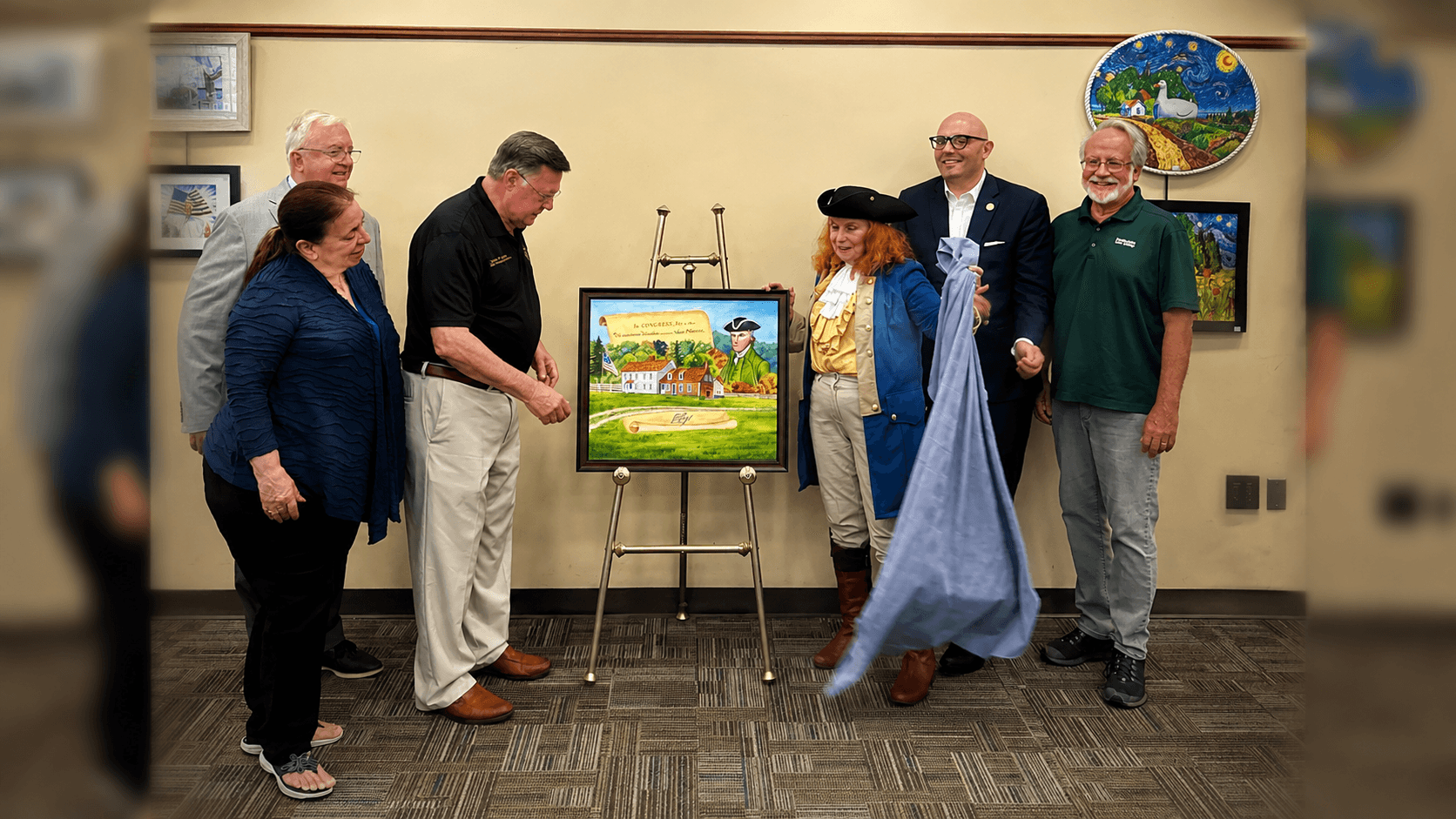
The painting was recently unveiled at the Nesconset Branch of the Smithtown Library before an audience that included Suffolk County officials, community leaders and Farmingdale State College President Robert Prezant.
Ryder-Thompson spoke exclusively with the South Shore Press about the inspiration, historical research and personal family connection behind the work.
South Shore Press: What inspired you to create a painting of William Floyd?
Elaine Thompson: My family fought in the American Revolution alongside George Washington, and one of my relatives was at Valley Forge. My father was a member of the Sons of the American Revolution, so American history was always very important in our family.
When I learned more about the William Floyd Estate and what Floyd and his family went through during the Revolution, I became inspired to paint him. He was one of four New Yorkers who signed the Declaration of Independence, but he was the only signer from Suffolk County. I felt that was something people here should know and remember.
I also wanted to do something special to commemorate the 250th anniversary of the United States. William Floyd was the perfect subject because his story is part of both American history and Long Island history.
South Shore Press: What did William Floyd and his family experience during the Revolutionary War?
Elaine Thompson: Floyd went to Philadelphia to serve in the Continental Congress, and his family had to flee to Connecticut after the British took over his Mastic property. The British occupied the estate, and the family could not safely remain there.
The Revolution was a terrible time for many families on Long Island. People lost their homes and property, and families were separated. The soldiers also suffered tremendously. I read a book about George Washington and Valley Forge, and I cried while reading it. The soldiers had very little food, inadequate clothing and sometimes no blankets. Knowing that one of my own relatives was there made it very personal for me.
South Shore Press: How did you determine what the William Floyd Estate looked like during the Revolutionary era?
Elaine Thompson: I toured the estate several times and studied documents from the National Park Service. The house that people see today is not exactly the house that existed in 1776 because additions and changes were made over the years.
The earliest known image I found was a painting from 1792, after Floyd had returned home following the Revolution. There was no photograph or complete image showing the property exactly as it appeared in 1776.
Fortunately, the National Park Service had a detailed document that included floor plans, window locations and information about the building’s construction. I studied where the doors and windows were located, what the shingles looked like and which additions had not yet been built. I also found information about materials Floyd purchased for later renovations.
I wanted the house in my painting to be as historically accurate as possible.
South Shore Press: Did you also study the grounds surrounding the house?
Elaine Thompson: Yes. I went back to the estate to photograph the windows, doors, road and surrounding property. I wanted to understand how everything looked together.
The road leading to the house is a dirt road, and that was an important detail. The estate also changed significantly after Floyd returned. It became less of a working farm and more of a place for the family to live and gather. I wanted my painting to reflect the earlier Revolutionary War period.
South Shore Press: How did you design the overall composition?
Elaine Thompson: I worked on different layouts for about two months before completing it. The estate is in the center, and I incorporated elements connected to the founding of the country.
The 13-star American flag appears in the painting. I wanted to see how that type of flag looked while actually flying, so when I saw one during an event in Port Jefferson, I took a photograph with my phone and used it as a reference.
I also used a copy of the Declaration of Independence to recreate the lettering at the top. I designed it with scrollwork surrounding the estate, and the bottom of the scroll features William Floyd’s signature.
The painting brings together the man, the estate, the flag and the document he helped make part of American history.
South Shore Press: The lettering appears very detailed. Was that difficult to create?
Elaine Thompson: It was very difficult because the canvas had a rough surface. To produce the small lettering, I had to use an extremely fine brush.
The original Declaration of Independence was created with typeset lettering, so I wanted my lettering to have that formal historical appearance.
I was trained as an illustrator at Farmingdale State College, now Farmingdale State University. We were taught hand lettering and traditional illustration techniques. We were trained in a style similar to artists such as Norman Rockwell, where you had to know how to paint lettering, objects and small details accurately.
That training helped me enormously with this painting.
South Shore Press: How did you decide how William Floyd himself should appear?
Elaine Thompson: The historical image I found showed his hair pulled back very tightly, and I felt the appearance was too severe for the composition I was creating.
I decided to show him wearing a Revolutionary War-style tricorn hat. To make sure the hat sat correctly on his head, my grandson posed for me while wearing one.
My grandson is a former Army Ranger and Marine, and he has posed for several of my paintings over the years. I have to see exactly how clothing or a hat sits on a real person before I can paint it properly.
South Shore Press: How long did the painting take to complete?
Elaine Thompson: I worked on it for approximately two months, including the research, visits to the estate, photography, sketches and different layouts.
A historical painting takes much longer than simply painting from one photograph. You have to combine information from many sources and make decisions about how everything would have appeared during a particular period.
I was very passionate about getting it right because William Floyd deserves to be remembered for what he sacrificed and what he contributed to the country.
South Shore Press: What was it like to finally unveil the painting?
Elaine Thompson: It was a wonderful event, and I was very grateful to everyone who attended. The unveiling was held at the Nesconset Branch of the Smithtown Library.
Suffolk Executive Ed Romaine was there, along with the county Legislature’s Presiding Officer Anthony Piccirillo. Suffolk Comptroller John Kennedy and his wife, Legislator Leslie Kennedy joined us, as did Farmingdale State College President Robert Prezant, was there with his wife and 101-year-old mother.
I wore my George Washington-style outfit because I wanted the unveiling to reflect the Revolutionary War theme of the painting.
South Shore Press: What do you hope people take away from the painting?
Elaine Thompson: I hope people become interested in William Floyd and understand how important he was. Many people on Long Island do not realize that someone from Suffolk County signed the Declaration of Independence.
I also hope they think about the sacrifices made by Floyd, his family and the soldiers who fought during the Revolution. These were real people who lost homes, endured hardship and risked everything for the creation of the country.
History becomes more meaningful when people can see it. That is what I try to accomplish through my artwork.
South Shore Press: Does your family connection to the Revolution make this painting especially meaningful?
Elaine Thompson: Yes, it does. My maiden name is Ryder, and my father spent about two years researching and filing the documents establishing our family’s connection to the American Revolution.
The ancestor we have identified was Thomas Hubert, who served during the Revolution and was at Valley Forge. I believe there may be other Revolutionary War soldiers in the family line, but I still have more research to complete.
My father loved history, and I inherited that love from him. Painting William Floyd allowed me to combine my family history, my love of Long Island and my respect for the people who founded the country.
South Shore Press: What will happen to the original painting?
Elaine Thompson: The original painting is available for purchase. I have also produced affordable 12-by-18-inch prints that are available framed or unframed.
I am hoping the William Floyd Estate may be interested in carrying the prints in its gift shop, but people may also order them directly from me.
The artwork will be featured on my website, elainethompsonarts.com. People can also arrange to visit my home gallery in Bohemia, pick up a print or have one shipped.
About Elaine Ryder-Thompson
A Long Island native who lives and maintains a home gallery in Bohemia, Elaine Faith Ryder-Thompson has created an extensive collection of historical portraits, scenic works and commemorative paintings.
Her subjects include George Washington, Theodore Roosevelt, Ronald Reagan, Pope Francis, Derek Jeter, Elvis Presley, the Statue of Liberty, Long Island lighthouses, the Big Duck, the Smithtown Bull, Riverhead Raceway, Davis Park and numerous golf championships held at Bethpage State Park.
She has produced artwork connected to the U.S. Open, the PGA Championship and the Ryder Cup at Bethpage Black. One of her most prominent commissions came from President Ronald Reagan for the official poster design of the National Vietnam Veterans Memorial Statue in Washington, D.C.
Ryder-Thompson was trained as an illustrator at Farmingdale State College and later worked as a graphic designer for the Town of Islip. While there, she helped design a book documenting George Washington’s historic tour of Long Island.
Her interest in the American Revolution is also deeply personal. Her father established the family’s membership in the Sons of the American Revolution through the Ryder family line. Their ancestor, Thomas Hubert, served in the Revolution and endured the Continental Army’s winter encampment at Valley Forge.
More information about Ryder-Thompson and her artwork is available at elainethompsonarts.com.
You Might Also Be Interested In

Two Rabid Raccoons Found in Bay Shore and Babylon
Long Island Marks 9/11's 25th Year With Ceremonies, Health Outreach
Suffolk’s biggest high schools get a hard look in new U.S. News rankings