

Suffolk’s biggest high schools get a hard look in new U.S. News rankings
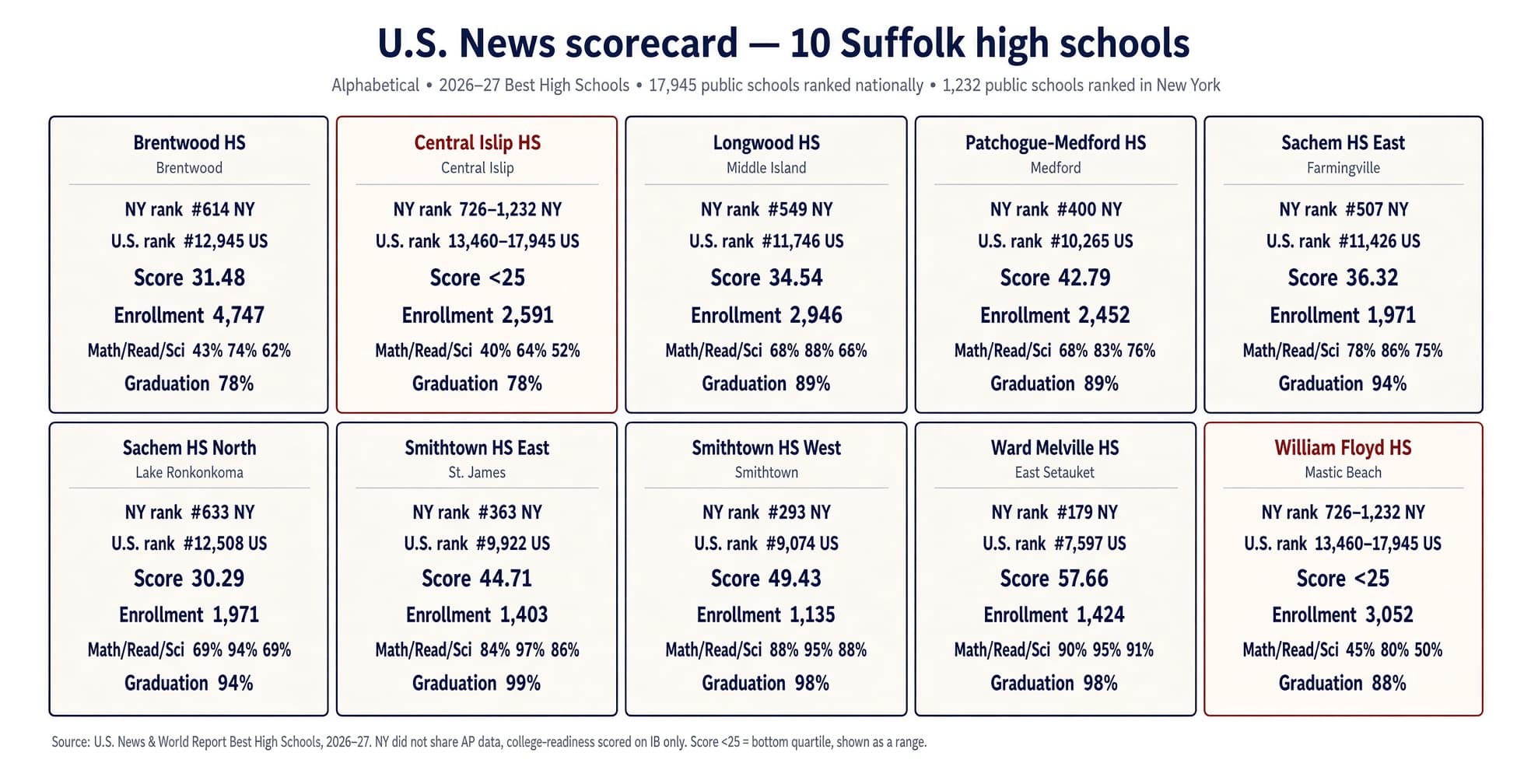
U.S. News & World Report has released its 2026–27 Best High Schools rankings, covering 17,945 public high schools nationwide and 1,232 in New York. The list is built from Regents results, graduation rates, and a college-readiness measure. New York’s Education Department did not let the College Board share Advanced Placement data, so that last piece was scored only on IB exams.
For the ten large Suffolk campuses that dominate Section XI’s upper divisions — Brentwood, Central Islip, Longwood, Patchogue-Medford, Sachem East, Sachem North, Smithtown East, Smithtown West, Ward Melville, and William Floyd — the local picture is not encouraging. Only seven of the ten land in the top half of New York schools. Ward Melville is the strongest of the group at No. 179 in the state and No. 7,597 in the country, with an overall score of 57.66. Smithtown West is next at No. 293 statewide, then Smithtown East at No. 363, Patchogue-Medford at No. 400, Sachem East at No. 507, Longwood at No. 549, and Brentwood at No. 614, just inside the midpoint.
Sachem North falls just outside that cut at No. 633. William Floyd in Mastic Beach and Central Islip Senior High School finish below the 25th percentile. U.S. News does not print a single rank for schools in that band. It prints a range — 13,460 to 17,945 nationally, 726 to 1,232 in New York — and an overall score of “less than 25.” That is a courtesy. It keeps the magazine from hanging a last-place number on buildings that finished near the bottom of a list of nearly 18,000 schools.
The scorecards underneath those ranks are what should bother people. Brentwood’s Regents proficiency is 43 percent in math, 74 percent in reading, and 62 percent in science. Graduation is 78 percent. Central Islip is 40, 64, and 52 on the same tests, with a 78 percent graduation rate. Floyd is 45, 80, and 50, with 88 percent graduating. Even some schools that clear the state midpoint are not clearing a high bar on math. Longwood is at 68 percent math proficiency. Patchogue-Medford is the same.
State and county leadership ought to ask why so many of the county’s largest high schools sit this far down a national list, and why so many students leave without showing proficiency in the subjects the state itself tests. The children in these buildings are not a rounding error. Brentwood alone enrolls 4,747. Floyd enrolls 3,052. Longwood is just under 3,000. Central Islip is about 2,600. These are the schools that serve the bulk of Suffolk teenagers.
What has been on the policy agenda for our state and county officials instead is a different list. Officials have talked about blocking data-center construction, banning artificial intelligence in schools, putting up new police stations, and expanding sewer systems. These ideas may have their own merits or arguments. None of them teaches a ninth grader algebra. A ban on AI in classrooms does not raise a Regents pass rate, and likely harms it. A new police precinct does not change a 78 percent graduation rate. In some cases the agenda actively pulls time, resources, and attention away from the work of running a school.
Suffolk should treat this ranking as a warning, not a press release to file. Someone has to identify why students in the largest schools are trailing on math, science, and completion. Someone has to decide which people produced that result and whether they should keep their jobs. Then the county has to bring in people who know how to run a high school — people who can staff classrooms, set a curriculum, and cause it to work.
Rankings are imperfect. U.S. News is one formula, and New York’s missing AP file made every school in the state look weaker on college readiness than it might have with full data. That does not erase the Regents numbers or the graduation rates. Those come from the state’s own tests and the state’s own completion counts.
The children sitting in these classrooms will be the county’s workforce, its taxpayers, and its next set of parents. If Suffolk wants a different outcome than a pair of large high schools parked in the bottom quarter of America, it has to change who is responsible for the schools and what they are asked to do. The buildings are already full. The question is whether anyone in charge intends to treat that as the main job.
You Might Also Be Interested In

Community Turns Out for Rifleman Run

Kassay Caught In Campaign Controversy

Miraculous Icon Draws Faithful To Shirley