
The Consequence of Elections and a Texas Case Study
A week after the Democratic sweep, gun bills are on file in Austin, and the governor-elect's record suggests Operation Lone Star could be ended
Texans who sat out the Nov. 3 election now have a week of evidence to study. Gina Hinojosa beat Gov. Greg Abbott by almost 8 points. Democrats took 83 of the 150 seats in the Texas House and won the lieutenant governor's office, which presides over the state Senate. Republicans will keep a 19-seat majority in the 31-member Senate. That majority can rewrite the chamber's rules, and it stands between the new agenda and the governor's desk.
On Nov. 9, the opening day of prefiling for the 2027 session, Democrats filed at least 14 bills to restrict firearms. Senate Bill 80 would make it a crime for anyone younger than 21 to buy or possess an assault weapon. House Bills 173, 771 and 806 would restrict who may receive certain semiautomatic rifles, and HB 857 targets recipients younger than 21. HB 610 covers some firearm transfers to that age group. HB 613 requires a national instant background check on private transfers. HB 659 orders licensed dealers to report multiple sales of guns or magazines to law enforcement. HB 618 limits magazine transfers to people barred from the matching firearm, and HB 660 requires people barred from owning guns to dispose of them. HB 218 creates extreme risk protective orders. HB 712 would allow local governments to restrict carrying in certain libraries, and HB 960 creates an offense for carrying certain weapons in public libraries.
These are significant new restrictions in a state famous for celebrating the Second Amendment.
The broadest of them, HB 606, would make it a crime for anyone under 21 to buy or possess any firearm, and its text writes no exceptions into the new offense. A Democratic House can now give it a hearing, though the Republican Senate keeps the votes to stop it.
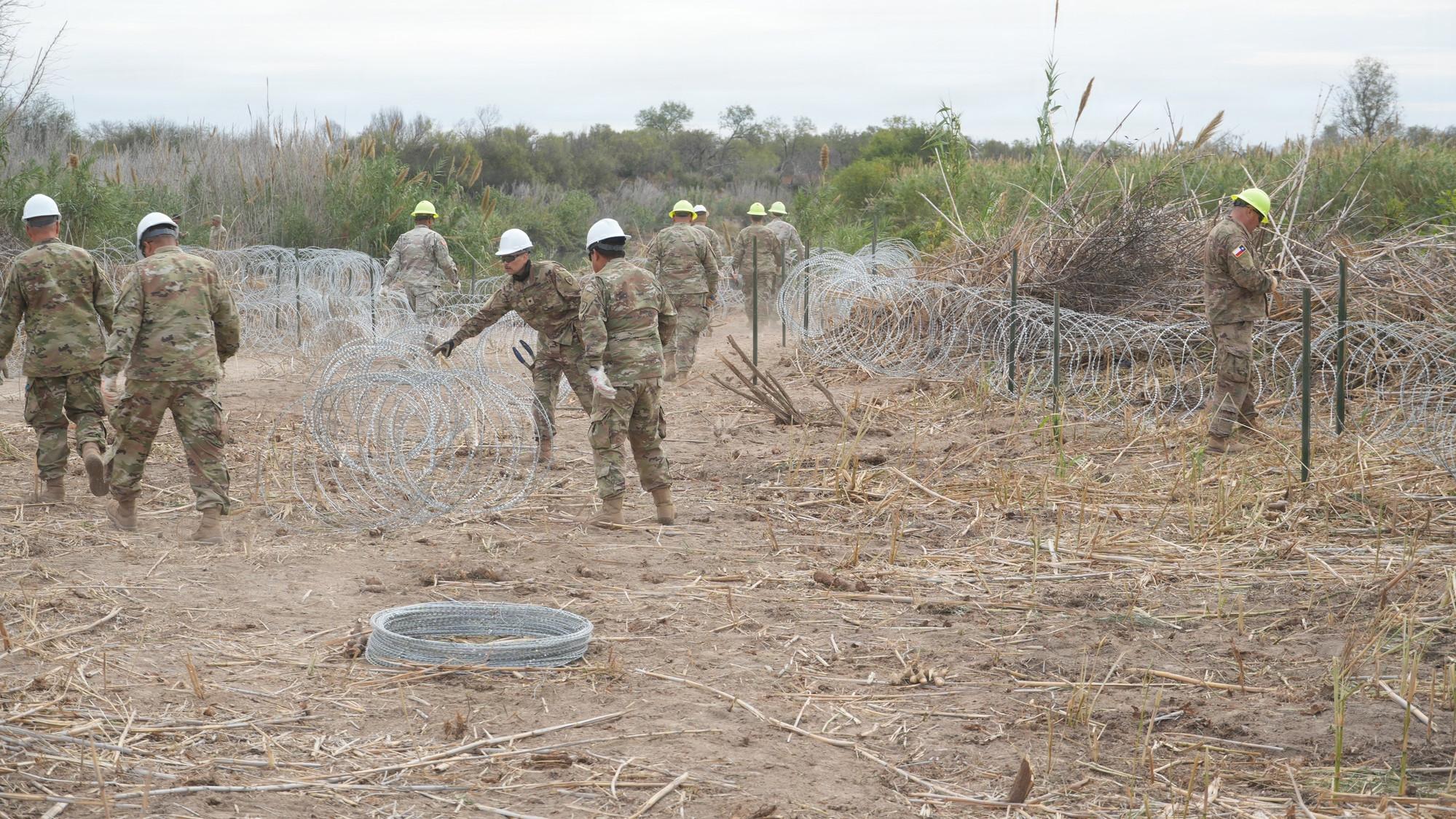
The larger stakes sit on the Rio Grande. The 2026-27 state budget, passed in 2025, sets aside $3.35 billion for border security across 13 agencies, by the Legislative Budget Board's count. The largest share, about $1.77 billion, goes to the Texas Military Department, whose Guard soldiers patrol the border and build temporary barriers for Operation Lone Star. Another $1.19 billion keeps state troopers on the border mission at full strength. In early 2024 Abbott credited the Guard with stringing razor wire along more than 100 miles of the border, and late that year his office announced a longer buoy line in the river at Eagle Pass.
As a state representative, Hinojosa voted against House Bill 9, the 2021 supplemental border security appropriations bill, when it passed the House 85 to 36 on Aug. 30 of that year. In an Oct. 2 statement she said Abbott spent "$11 billion in taxpayer money to grandstand," a figure from her campaign, and promised to secure the border without wasting money "on political theater." In a Rio Grande Valley television interview published Oct. 29, she said the operation "needs to only exist to make us safer" and called for "a review of Operation Lone Star." In August 2023 she called the buoys Abbott ordered into the river, with razor wire attached, "an atrocity."
Her record and public comments point toward a retreat from state border security. She opposed the 2021 money and calls the mission theater, and a governor with those views has little reason to keep paying for wire and soldiers once she commands the Guard.
Texas shares roughly 1,250 miles of border with Mexico, the longest stretch of any state. Ending Operation Lone Star would weaken the state's hold on that line and risk opening the floodgates to another surge in illegal crossings. Already a caravan of more than 1,000 migrants, mostly from Central America, has set out north through southern Mexico, and participants told reporters they hoped the Democrats' midterm wins would ease their way into the United States.
Rebuilding the Guard mission if crossings rose would take time and money, and that would only happen if the Republicans took back control of the state government. The state is potentially staring at years of chaos on the border with no effort to thwart it.
Her language on ICE is plainer. In January she urged Abbott to refuse "to provide state resources until DHS stops killing U.S. citizens and detaining our children." On Jan. 31 she posted "Get ICE out," and in remarks her campaign released from a rally that day she vowed to "never offer up Texas as a staging ground for operations that terrorize families and enrich his donors." In July she blamed ICE raids on corruption and wrote, "When I'm governor, that stops."
Cities read the returns quickly. Houston Mayor John Whitmire signed an executive order on Nov. 6 limiting police contact with ICE to people with an immigration warrant who face a jailable charge. "I also do this knowing that elections matter," he said in announcing it. Three council members introduced an ordinance to make it permanent. In San Antonio, three council members asked for a special meeting by Nov. 17 to weigh similar limits. State law, through the 2017 measure known as SB 4, bars local governments from policies that prohibit or materially limit immigration enforcement. Democrats have already filed House Bill 123 and Senate Bill 99 to repeal the separate laws requiring certain sheriffs to sign enforcement agreements with ICE.
Houston's order is already signed, and the bills filed on Nov. 9 go to a House that Democrats will control when the session opens on Jan. 12.
Open borders, protections for illegals who make it into Texas cities and restrictions on firearms? These aren't things people would generally associate with Texas. Yet that's where we are.
The election in early November is being characterized largely as a protest vote against the Trump administration, specifically the war in Iran and the related economic problems it has created. But elections have consequences, and the people whose hands are on the levers of power in our government have the ability to make profound changes to our lives. The emotion that drives a protest vote can often be well founded, but we must be mindful of the ancillary consequences to such an action. Texans will now live with the consequences of their choices, for better or, more likely, for worse.
You Might Also Be Interested In
Trump Says FBI Is Looking Into Huang Matter ‘In Terms of Something Else’ as Nvidia Opens Review
New York Republicans Fight Over Leadership and Campaign Direction After Losses

Voters beware: On ICE, Iran, and AI, be careful what you wish for. You might just get it.