
Now Trending: The MAGA Civil War
Trump called Tucker Carlson, Thomas Massie and Marjorie Taylor Greene "LOSERS ALL" this week, and underneath the name-calling is a real fight over who gets to define America First
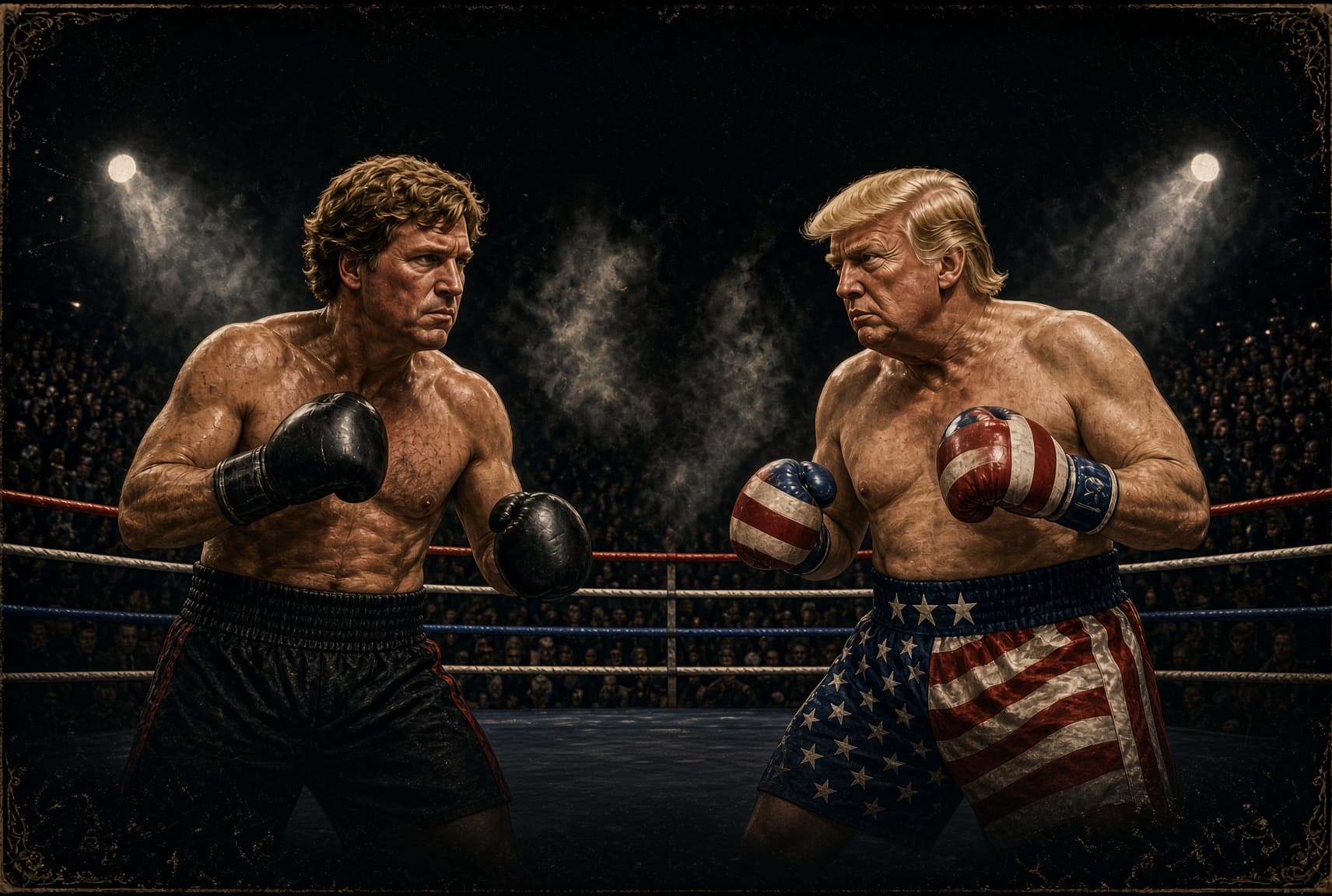
So this is where we are now, and it isn't new. The President of the United States spent part of his week on Truth Social calling a former Fox News prime-time host, a sitting-turned-former congressman, and one of his own most loyal foot soldiers in the House a bunch of losers. Not in a policy memo. Not through a spokesman. In a lengthy post, in all caps, on his own platform, because that's apparently how we settle things in 2026.
Here's what actually happened, stripped of the caps lock. President Trump tore into Tucker Carlson, Thomas Massie and Marjorie Taylor Greene in a Truth Social post reviving his feud with what's being described as a breakaway MAGA faction openly plotting against him. The post referenced an early-August gathering at Carlson's lodge in Maine, where Carlson reportedly hosted Massie, Greene and others who urged him toward a 2028 run, and Carlson has since vowed to help build a third party and stop backing the GOP. Trump's language was not subtle: "Tucker Carlson just met with Lightweight 'Former' Congressman, Thomas Massie, and Marjorie 'Traitor' Greene, LOSERS ALL!" he wrote, claiming Carlson's audience had "fallen through the floor" and calling him "a very Low I.Q." individual.
What got us here isn't personal, or not originally. It's Iran, and to a lesser extent Jeffrey Epstein. Once close political allies, Trump and Carlson have been on a collision course since the U.S. joined Israel in striking Iran back in February, a decision that led Carlson to publicly denounce the president in unusually harsh terms. He called the joint strikes "absolutely disgusting and evil" in an ABC News interview, warning it would "shuffle the deck in a profound way" for Trump's movement — and he didn't stop there, branding the war "Israel's war" and accusing the president of being a "slave" to Netanyahu's ambitions. By April, Carlson had gone further still, apologizing on his own show for having "misled" his audience into voting for Trump, a moment he described as genuinely tormenting.
So now you've got a real split, not a manufactured one. On one side, the anti-interventionist wing of MAGA — Carlson, Massie, Greene, and whoever shows up next at that lodge in Maine — arguing the president campaigned on ending endless wars and instead got talked into another one by the same foreign-policy blob he promised to burn down. On the other side, the loyalists who see this as sour grapes from people who lost their seat at the table and are now trying to build relevance, or a third party, or a 2028 campaign, off of betrayal narratives. And there's a third strand worth naming honestly: the theory, whispered more than shouted, that a chaotic MAGA split conveniently benefits everyone who wants the GOP coalition fractured heading into the midterms — establishment Republicans who never liked the populist wing to begin with, defense contractors who don't want an isolationist anywhere near the Situation Room, and Democrats who'd love nothing more than a three-way split on the right in 2028. Nobody's proven that. But it's the kind of thing people on that side of the internet are absolutely saying out loud.
In my opinion, the instinct driving Carlson's crowd deserves more respect than "LOSERS ALL" gives it. The suspicion that the same permanent Washington apparatus — military contractors, intelligence agencies, the donor class in both parties — keeps steering presidents who promise peace right back into foreign wars is not a fringe theory. It's a pattern going back decades, and it's exactly the kind of elite manipulation I think people are right to distrust regardless of which party is doing the steering. If Trump genuinely reversed course on a core campaign promise, the people who voted for him restraint over intervention have every right to be furious about it, and calling them traitors doesn't make the argument go away.
A party calling itself out isn't necessarily bad. That's a healthier thing for a party to do than the alternative, which is pretending everyone agrees. It is perceived that public infighting is bad for political outcomes, and that is more a reflection on a mindless electorate than honest intellectual debate. We should welcome the infighting and listen to the merits of the arguments put forth, then decide for ourselves.
The country should be paying attention to the substance here — the war, the broken promise, the third-party threat — instead of just retweeting the insults, because whoever wins this argument inside the Republican Party is going to shape what "America First" means the next time someone runs on it.
You Might Also Be Interested In
Garbarino Gets the Nod, But NY-02 Deserves More Than Politics as Usual
South Shore Press Endorsement: Saritha Komatireddy for NYS Attorney General
The Power Behind the Ballot: Why Party Leadership Matters