
Trump and Xi Meet in Shenzhen and Agree to Draft a Stability Action Plan
In Shenzhen for APEC, President Trump met Xi Jinping and held a first three-way session with Vladimir Putin. Official texts pledged a stability action plan and a four-point peace declaration. Thursday's texts set no new tariff rates or rare-earth quotas.
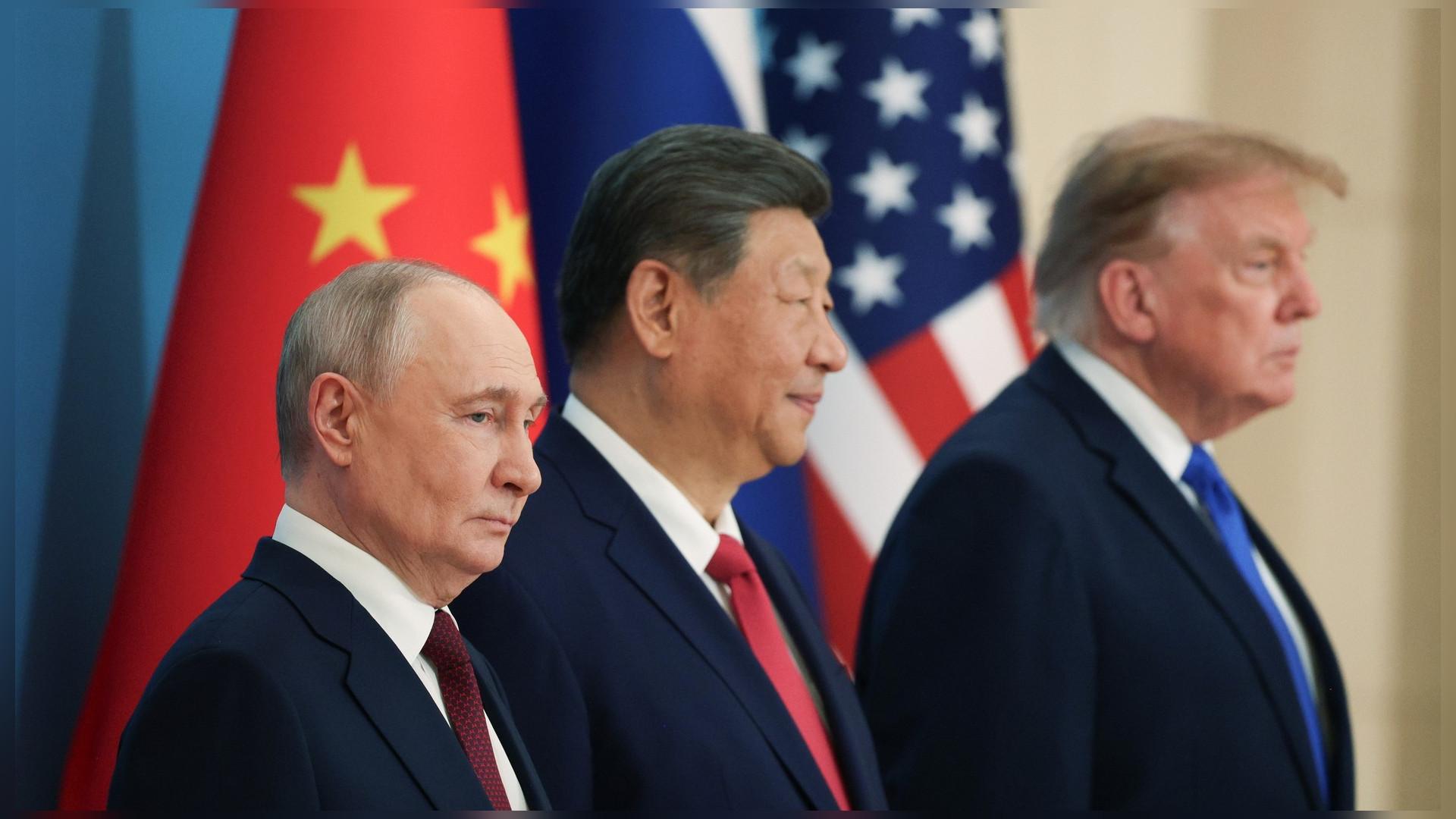
President Donald Trump met Chinese President Xi Jinping in Shenzhen on Thursday, Nov. 19, during the 33rd APEC Economic Leaders' Meeting. He arrived Wednesday, on his second trip to China this year after a May state visit to Beijing, and held a separate session with Russian President Vladimir Putin before the three sat down together for the first time. Thursday's talks produced a pledge to "formulate an action plan on building a constructive relationship of strategic stability," and a four-point "Heads of State Declaration toward Peace." Thursday's official texts set no new tariff rates or rare-earth quotas.
On Wednesday afternoon, Xi greeted the president at Shenzhen Bao'an International Airport, returning the welcome Trump provided in September when Xi visited Washington. A Chinese Foreign Ministry account said Trump thanked Xi for the gesture and said he was "very happy to visit the great country of China again."
The two presidents met Thursday afternoon. In the Foreign Ministry's account, Xi said meetings from Beijing to Washington earlier this year had produced agreement on "a constructive China-U.S. relationship of strategic stability," placed on a footing of respect, fairness and reciprocity. He called for more communication on trade, further work on narcotics control, and coordination to keep artificial intelligence "always under human control." On Taiwan, he said the U.S. side "should keep doing the right thing and avoid major setbacks in China-U.S. relations." The same readout said Trump called cooperation on fentanyl "productive," asked for more work on farm products, energy and "super intelligence," and stated, "The United States does not support 'Taiwan Independence.'" The White House had issued no written communique as of Thursday morning, leaving that Taiwan line as Beijing's account.
In public remarks at the opening of the meeting, Trump said he and Xi had "formed an outstanding personal relationship." He said he would ask China to expand farm purchases, citing what he called an "insatiable appetite." He also said both governments wanted to help bring the war in Ukraine to a close, and that oil should keep moving through the Strait of Hormuz. Both sides, the Foreign Ministry said, judged the meeting "positive and constructive" and agreed to "formulate an action plan on building a constructive relationship of strategic stability."
A May White House fact sheet said China had approved a first order for 200 Boeing aircraft, pledged purchases of at least $17 billion a year in American farm goods for 2026, on a prorated basis, and for 2027 and 2028, on top of earlier soybean commitments, and would address U.S. concerns about shortages in rare-earth and other critical-mineral supply chains. A September fact sheet, issued during Xi's state visit to Washington, described a "30-for-30" plan in which each side listed about $30 billion in non-sensitive goods for possible tariff cuts, still subject to each country's domestic legal process, and said China would take a minimum of 10 million metric tons of American coal in 2027 and again in 2028.
Before the Shenzhen meetings, China's Customs Tariff Commission said it would continue a two-month pause on a 24 percent extra duty on American goods, starting at 1:01 in the afternoon on Nov. 10, while keeping a 10 percent extra duty in place. The Ministry of Commerce and the General Administration of Customs said named 2025 export-control announcements, Nos. 55, 56, 57, 58, 61 and 62, would remain paused from Nov. 11, 2026, through Jan. 10, 2027. The U.S. Trade Representative, at the president's direction, further suspended Section 301 maritime and shipbuilding measures until Jan. 10, 2027, and separately extended 178 product exclusions "through 11:59 p.m. eastern time on January 9, 2027."
The three leaders also issued official Chinese and Russian texts of the "Heads of State Declaration toward Peace." They pledged United Nations reform, an increase in "the production and supply of refined petroleum products," and respect for the immunities of state officials. They said the International Criminal Court and similar bodies "must not abuse their jurisdiction," repeated that "a nuclear war cannot be won and must never be fought," and said they would "conduct a dialogue on reducing nuclear risks." In a Kremlin transcript of the opening exchange, Trump called the three-way session a first, said the three countries were "uniquely positioned" to "discuss how to reduce the number of nuclear weapons," and said, "We're not going to let Iran have a nuclear weapon."
The Shenzhen meetings closed with that pledge to draft a stability action plan and with the four-point declaration on the United Nations, energy, official immunities and nuclear risk. The mid-November pauses apply only to the Chinese additional-tariff suspension described by the Customs Tariff Commission, the named 2025 export-control notices, the Section 301 maritime and shipbuilding measures, and the 178 product exclusions, each on the dates written into those official texts. The commercial commitments recorded around the visit remain those set out in May and in September.
You Might Also Be Interested In
Danish Parliament Approves Greenland Defense Agreement With the United States
Five EU Nations Open Talks With Rwanda on a Hub for Rejected Migrants
Are You Ready for the Next Chokepoint Crisis? Houthis Shutting Down Mandeb Strait