

Retailers Keep Beating Earnings, and Wall Street Keeps Debating What That Means
Strong headline earnings and reaffirmed guidance are colliding with a stock market that can't decide whether resilient results are good news or a warning sign about an overheating economy
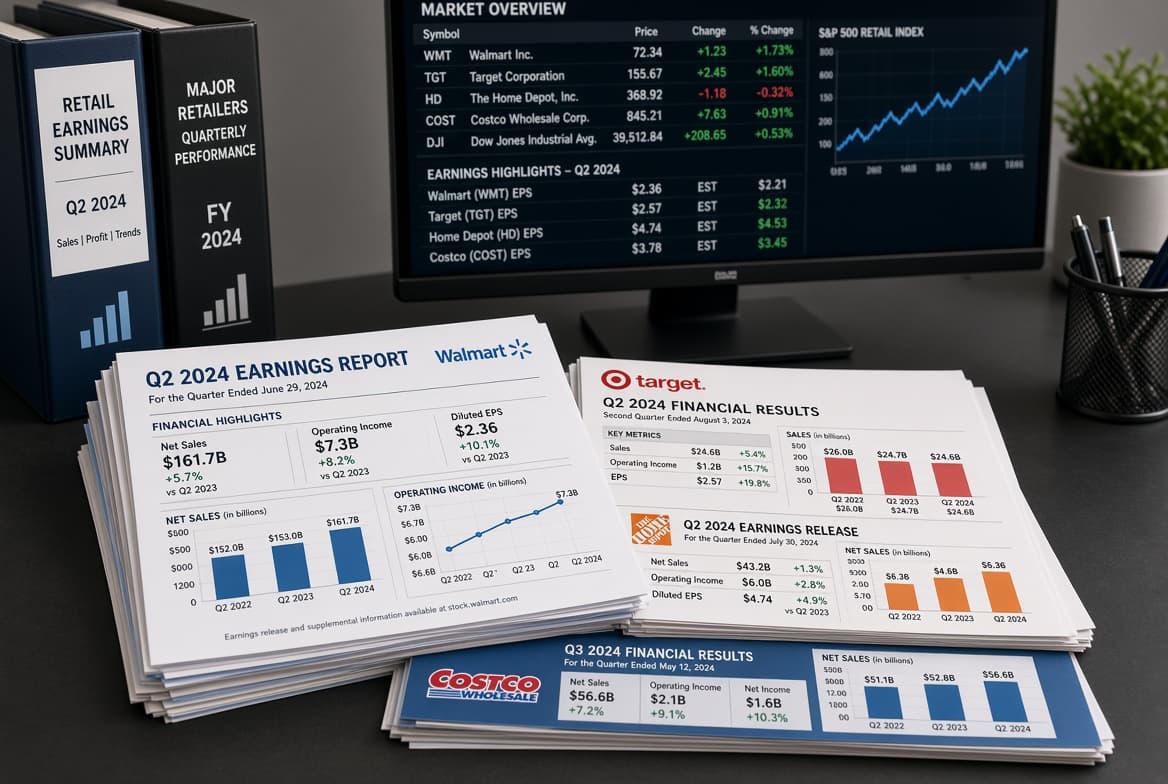
Something odd has been happening in retail earnings this quarter, and it's not really about any one company. Reports have come in ahead of estimates across a range of names — jewelry, off-price, beauty, discount retail — with management teams raising full-year guidance and pointing to solid holiday setups. That should read as unambiguously good. Instead, the reaction on trading desks has been a mix of relief, suspicion, and outright selling, and the reason has less to do with the numbers themselves than with what's sitting underneath them.
Start with tariffs. A meaningful chunk of this quarter's margin outperformance is coming from tariff refunds and adjustments working their way back through corporate income statements — one-time or semi-recurring boosts that flatter operating margins without reflecting any underlying improvement in the business. Analysts parsing the details have specifically flagged that some retailers beat even excluding that benefit, which matters, but the market has clearly grown wary of headline beats it can't fully explain. When a beat is partly a policy artifact, professional investors discount it, and increasingly they're doing so out loud.
Then there's the macro backdrop these companies are guiding into. Every retail management team on an earnings call this month has had to address the same open question: what happens to their customer if borrowing costs keep climbing and energy prices stay elevated. Off-price retail — usually the sector that benefits when shoppers trade down — has actually fallen over 20% as a group in the past month, which is not the pattern you'd expect if investors were confident lower-income consumers had more room to spend. That's a tell. The market is pricing off-price retail like a segment facing pressure, not a beneficiary of trade-down behavior, which suggests professional money doesn't fully believe the consumer resilience story even as individual quarters beat estimates.
There's also a structural change happening inside these businesses that's easy to miss in the quarterly noise: several retailers are now openly discussing how AI-driven agentic commerce — shopping assistants and bots doing the actual purchasing — could reshape their relationship with customers within a year or two. That's not a next-decade problem anymore. It's showing up in investor questions on nearly every retail earnings call this month, and it adds a layer of uncertainty to guidance that didn't exist eighteen months ago. A company can beat this quarter's numbers cleanly and still get punished if investors think its distribution model is about to be intermediated by a chatbot.
Strong retail earnings season are not a confirmation that the consumer is thriving. The beats are real, but they're propped up by tariff mechanics that won't repeat indefinitely, and the market's own behavior — selling off-price stocks even as they report solid numbers — suggests sophisticated investors expect the lower-income and middle-income shopper to come under more pressure, not less, as rates climb further. Retail earnings this fall are less a scoreboard of consumer health than a hedge against a consumer story nobody is fully confident in. Watch the holiday guidance updates in October and November — that's when this quarter's ambiguity either resolves into confidence or confirms the market's skepticism.
You Might Also Be Interested In

SpaceX and Tesla Boards Have Committees Studying a Merger, Musk Says, but No Deal Is Set

Musk Says SpaceX Closed a Starlink 'Loophole' as Ukraine Reports Service Restored

Micron Needs Power Albany Is Rationing