

ESM Students Earn Spot In Global Science Bank
Seven Eastport-South Manor students have moved beyond the traditional high school science lab, earning a place for their research in a global scientific archive used by professional researchers around the world.
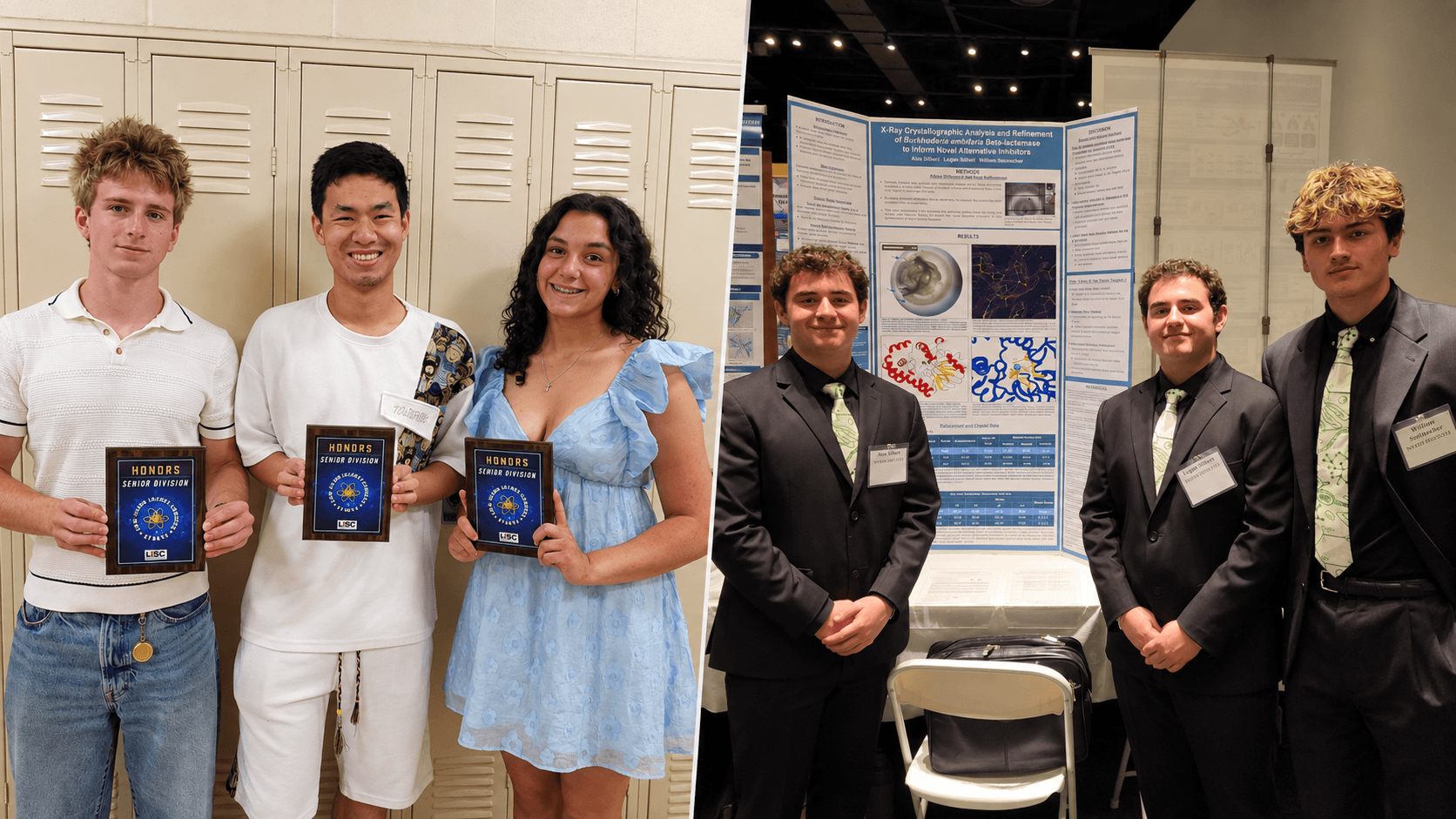
Seven Eastport-South Manor students have moved beyond the traditional high school science lab, earning a place for their research in a global scientific archive used by professional researchers around the world.
After three years of work, their research, “Crystal Structure of a Beta-lactamase from Burkholderia ambifaria,” has been published in the Protein Data Bank, the single worldwide archive for experimentally determined three-dimensional structures of proteins, DNA, RNA and other biological macromolecules.
The achievement puts the students’ work into the same scientific resource used by researchers studying everything from disease and drug development to agriculture, biotechnology and energy.
Established at Brookhaven National Laboratory in 1971 with just seven structures, the PDB now contains more than 250,000 experimentally determined structures contributed by scientists worldwide. Its files are downloaded millions of times each day, making it a fundamental resource for modern structural biology.
For high school researchers Logan Silbert, Alex Silbert, William Steinacher, Jameson Ackley, Michell Zheng, Ava DiDonna and Sean Doherty, publication means their work has become part of that permanent, freely accessible scientific record.
The students worked alongside Eastport-South Manor teacher Robert Bolen, collecting data at Brookhaven National Laboratory’s NYX beamline and spending countless hours analyzing and manually refining the protein's three-dimensional structure.
The PDB is more than an online collection. Submitted experimental structures undergo scientific validation and biocuration before becoming part of the archive, where each receives its own PDB identifier and can be accessed and cited by other researchers.
Knowing a protein’s three-dimensional structure can help scientists understand how it functions and interacts with other molecules, information important to research involving human and animal disease, food production and biotechnology.
The district called the publication the culmination of “three years of research, collaboration and perseverance” and congratulated the seven students and Bolen for contributing their work to the broader scientific community.
You Might Also Be Interested In
SCPD Officer Honored for Dramatic Pool Rescue
Illegal Immigrant, Repeat DWI Offender Gets Up To 7 Years

Blue Öyster Cult Founder Rocks LIMEHOF
