

The WNBA’s Moment of Truth: Define the “W” or Admit the Farce
For the better part of a decade, Americans have endured a relentless campaign of gaslighting from the cultural left. Longstanding, biologically grounded definitions of sex and gender were declared optional. Bathrooms, locker rooms, and athletic competitions were thrown open to anyone who claimed the opposite identity. Even the English language was rewritten under threat of social and professional destruction. Question any of it and you were labeled a bigot, a hater, or worse. The central dogma of this movement, like so many other progressive enthusiasms, insisted that we must “respect everyone’s truth.” Science, logic, chromosomes, and observable reality were secondary. Whatever an individual declared became inviolable, and the rest of society was required to comply.
Western countries enacted and enforced policies protecting these assertions. In some places people have faced investigation or arrest for “misgendering” or refusing preferred pronouns. For most ordinary Americans this whole spectacle remained a distant, irritating sideshow—unless you had the unfortunate experience of colliding with one of these lunatics in a restaurant or airport security line, where a man in a dress demanded recognition as “Nancy” under threat of outrage. The real damage, however, has been concentrated where it hurts young people most: sports.
Sports exist for reasons far deeper than trophies. We enroll our children not because we believe they will become professionals, but because the playing field is a laboratory for life. Goal-setting, discipline, perseverance, teamwork, graceful winning, dignified losing, and the stubborn refusal to stay down after failure are not optional soft skills. They form the core of the American character—the competitive, inventive, resilient spirit that built this country. When boys and men are allowed to compete in categories reserved for girls and women, that laboratory is rigged. Outcomes are predetermined by male physiology. The meritocracy of sports is perverted and opportunities are lost.
One of the clearest illustration remains Lia Thomas. As Will Thomas, a mediocre male swimmer at the University of Pennsylvania, he attracted little attention. After declaring a female identity, the same athlete became an Ivy League and national champion in women’s events. Real female swimmers who rose before dawn for laps, skipped social events to maintain training, and dreamed of scholarships or national berths lost places on the podium, team spots, and opportunities. Championship events that would otherwise be a platform to celebrate the athletes and their hard work were turned into media spectacles about Thomas, often with a focus on the bigotry of those voicing any opposition. Years later Penn quietly adjusted some of those records and acknowledged the competitive disadvantage inflicted on female athletes. Removing a name from a wall does not restore the stolen experiences or the trust those young women lost in a system that abandoned them.
Fast-forward to 2026 and the WNBA. The league has long functioned as a showcase for progressive orthodoxy on gender, sexuality, race, and athletics. Earlier this season Indiana Fever forward Sophie Cunningham was asked whether men should be permitted to compete in the WNBA. She answered with basic fairness: no, because it would be unfair to biological women, while still urging love for everyone. That measured response triggered protests, on-court retaliation, and media condemnation branding her a bigot. A player simply defending the integrity of women’s competition became a villain in her own league.
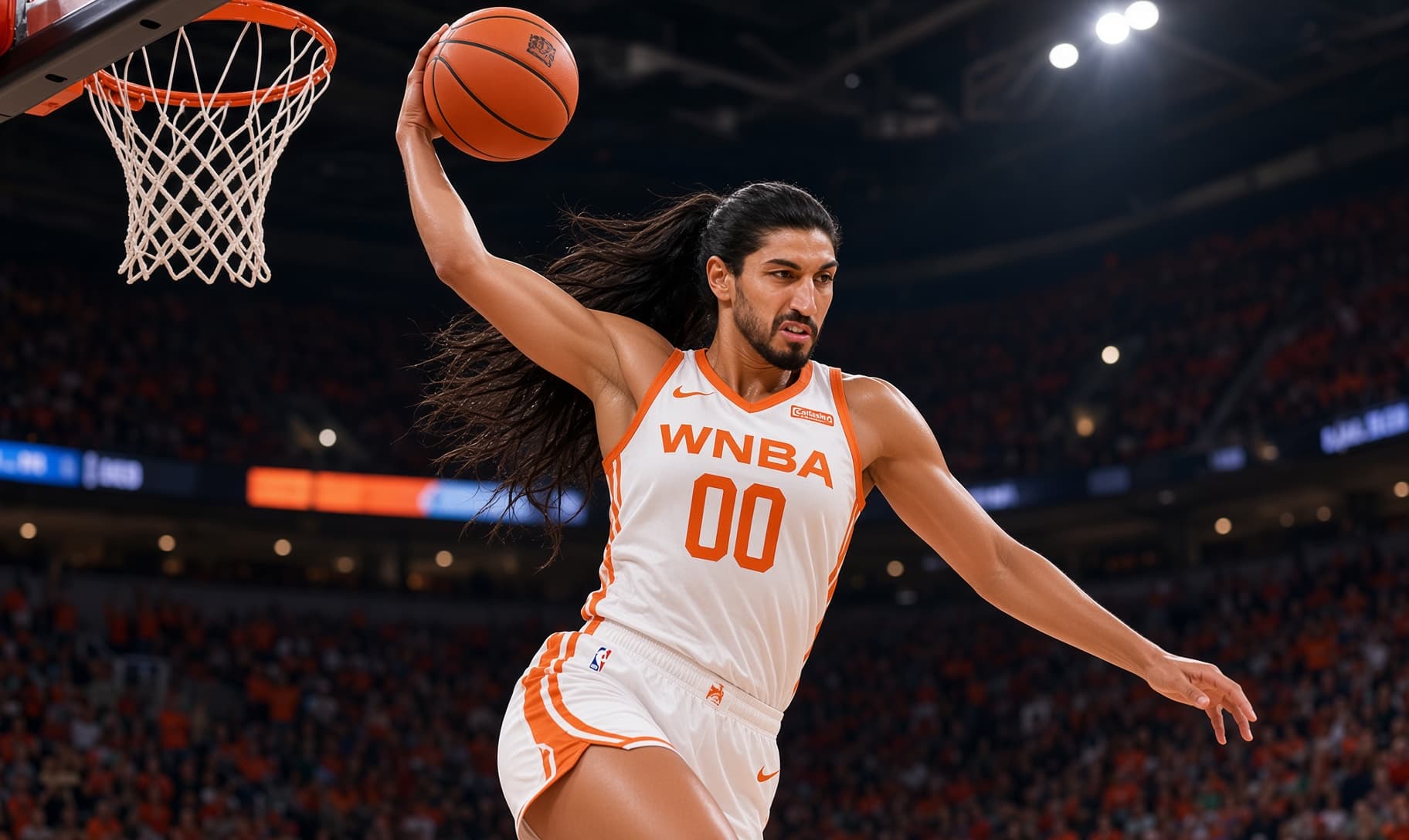
Then came the clarifying chaos. Former NBA center Enes Kanter Freedom—6-foot-10, 250 pounds, an 11-year professional who averaged double-digit points and rebounds—announced he was declaring for the 2027 WNBA Draft. He and his team had examined the league’s eligibility framework around self-identification and inclusion. If declaring oneself a woman is sufficient, he said, then he meets the criteria. Other former NBA players, including Royce White, quickly followed, stating they would identify as women for the purpose of competing. The WNBA, which states that “only players who are women are eligible,” now faces the question progressive activists have spent years refusing to answer: What is a woman?
This is the trap the left built for itself. For years the movement celebrated self-declaration as the sole requirement and branded any demand for more as bigotry. Thousands of males have walked through society in women’s clothing on nothing more than a verbal claim, and institutions rushed to affirm them. Suddenly, confronted with large, athletic former NBA players making the same claim, activists scramble for new goalposts. Some now insist medical transition—hormones, surgery, and the rest—is required. That move immediately undermines the “respect their truth” mantra applied to everyone else who simply declared. Others retreat into vague language about “lived experience.” The contradictions pile up in real time.
Famously, current Supreme Court Justice Ketanji Brown Jackson, during her confirmation hearing, suggested she could not possibly define what a woman is because she “is not a biologist.” Amazing. But now the WNBA must officially answer that question. The league’s collective bargaining agreement offers no detailed transgender policy that resolves the tension. It simply says only women may play. Activists who once insisted no one can define womanhood now demand the league invent a definition that excludes Kanter while preserving the ideology. The result is institutional paralysis dressed up as compassion.
Gaslighting can persist for a long time. It produces victims—female athletes denied fair competition, scholarships, and the formative lessons of honest contest, as well as the legion of young people coerced into a "trans life" because of the societal promise of being hailed a courageous hero—all while its promoters congratulate themselves for their own bravery. Yet reality has a way of reasserting itself. Biological sex is not a costume or a feeling. Male advantages in strength and power sports are not bigoted inventions; they are measurable facts. When the abstract slogan collides with a 250-pound former NBA center demanding equal application of the rules, the slogan fails.
The WNBA now has an opportunity, perhaps an obligation, to provide clarity. Define the “W.” State in plain language whether eligibility rests on biological sex, medical intervention, or pure self-identification. Apply the standard consistently. Anything less continues the deception that has already cost a generation of female athletes opportunities that cannot be recovered. Truth does not require permission from activists or media gatekeepers. It simply waits for the moment when the narrative becomes untenable. That moment has arrived on the professional women’s basketball stage. The league can either protect the category it claims to champion or admit that the category never mattered. Americans watching will notice which choice it makes.
You Might Also Be Interested In

Top 10 Keepers For 2027

Injury Impact Report: September 22, 2026

Belmont Park Reopens After Three-Year, $555 Million Reconstruction