

German Authorities Call Berlin Pride Van and Knife Attack Islamist Terrorism
A fugitive 21-year-old suspect drove a minivan into a crowd and attacked people with a machete, killing one
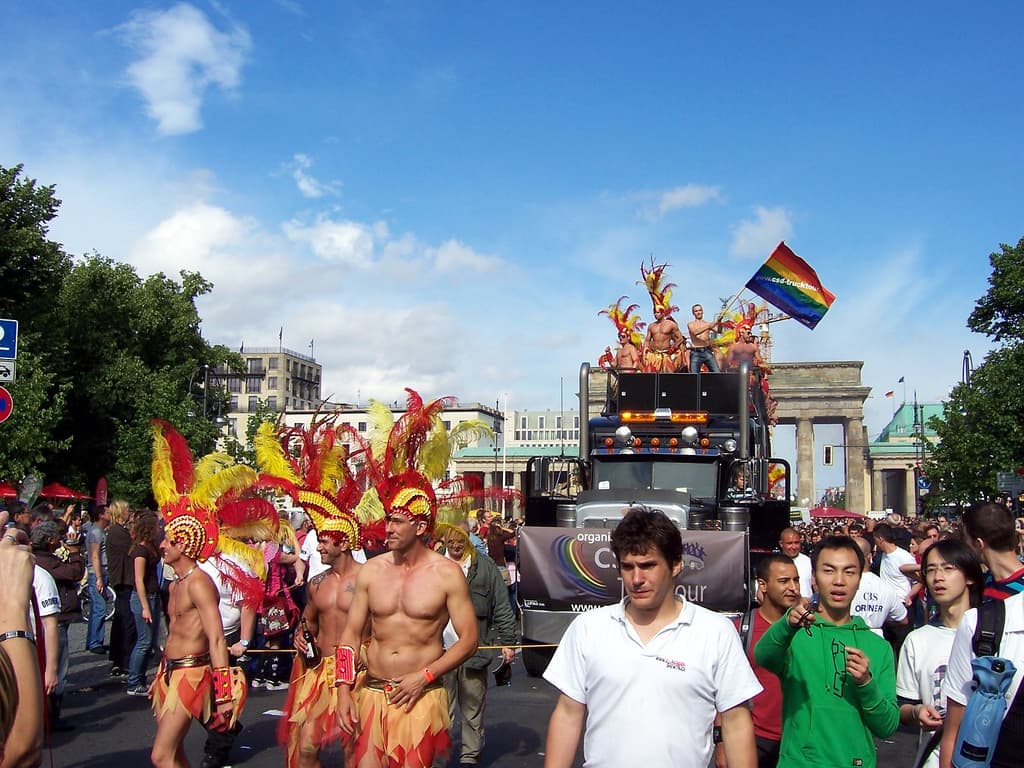
German officials announced Sunday that a van-ramming and machete assault near Berlin's Pride festival the night before was an act of Islamist terrorism, as a sweeping manhunt for the still-at-large suspect continued across the city.
One person died and at least 29 were wounded Saturday night after a man steered a minivan off a road and into a group of people on foot in Tiergarten park, near the Brandenburg Gate, then got out and set upon bystanders with what witnesses described as a machete. The rampage unfolded around 10 p.m. local time, close to one of Europe's largest LGBTQ celebrations. Several of the injured were in critical condition.
German Interior Minister Alexander Dobrindt named the primary suspect as Abdul Ballout, 21, a German citizen of Lebanese background. "Everything we see here indicates that we are dealing with an Islamist terrorist attack," Dobrindt said at a press conference near the scene Sunday.
Dobrindt said Ballout had previously come to the attention of authorities through a pattern of criminal behavior, signs of radicalization and documented connections to Islamist circles. He had been convicted of a criminal offense and given a sentence of one year and 10 months, which was suspended rather than carried out.
German media reported that Ballout was a supporter of the Islamic State group and had traveled to the Middle East last year in an unsuccessful attempt to join the organization. A German court subsequently found him guilty of taking preparatory steps toward a serious act of subversive violence, according to those reports.
The white minivan veered off a roadway just before 10 p.m. and struck pedestrians along a path in Tiergarten before coming to rest against a tree. Officers who arrived at the vehicle found it abandoned. Witnesses reported that the driver fled on foot. Throughout Sunday, helicopters and police units drawn from multiple German states combed Berlin in search of Ballout. Authorities described him as roughly 1.90 meters — about 6 feet 3 inches — tall, slender, with black hair, and last seen wearing a black hoodie and white trousers. The public was cautioned not to confront him, as he may be armed.
In the early hours of Sunday, officers searched a residence in Berlin's Schöneberg district but did not locate him there.
The violence compelled organizers to bring the annual Christopher Street Day parade to an early end; the event is one of the continent's premier Pride gatherings. Hundreds of thousands of people had filled streets across the city during the day's warm weather. "It's one of the worst days for the queer community and a day I personally hoped I'd never have to experience," said Julian Methig, who had been attending the event.
German Chancellor Friedrich Merz called on the country to resist letting the attack sow division. "We will think about consequences, we will defend our freedom," Merz said. He had earlier condemned what he called a "heinous act" directed against German society as a whole. The flag at the Bundestag, Germany's parliament, was lowered to half-staff.
On X, reaction focused heavily on the question of how Ballout had remained free to carry out the attack. Users on X pointed out that German authorities had previously identified Ballout as an Islamist threat, arrested him abroad in Lebanon, and returned him to Germany for prosecution — only for his conviction to result in a suspended sentence. That detail drew widespread criticism and renewed questions about the adequacy of Germany's approach to suspects with documented ties to radical networks.
The assault came as Germany has remained on elevated alert after a succession of vehicle and knife attacks in recent years. It also rekindled questions about how a suspect with an established criminal record and known connections to radical Islamist networks had been free to carry out such violence.
Pope Leo XIV, at the close of his weekly Sunday prayer, appealed for peace and called on all parties in ongoing regional conflicts to "reject new military actions and unilateral decisions" that undermine the status of holy sites of every faith — remarks that came as violence also escalated in the Israeli-occupied West Bank.
You Might Also Be Interested In
Germany's AfD Claims Historic Win in Saxony-Anhalt State Election
Russia Strikes Ukraine's Intelligence HQ as U.S. Envoys Head to Region

How Much Oil and Gas Does The Earth Have Left To Give?