What Jeffries's Promise to Clean Up the Supreme Court Could Mean in a Democratic House
Hakeem Jeffries pledged on Nov. 22 to clean up Congress, the Supreme Court and the administration, and Court measures already on file require Republican help in the Senate
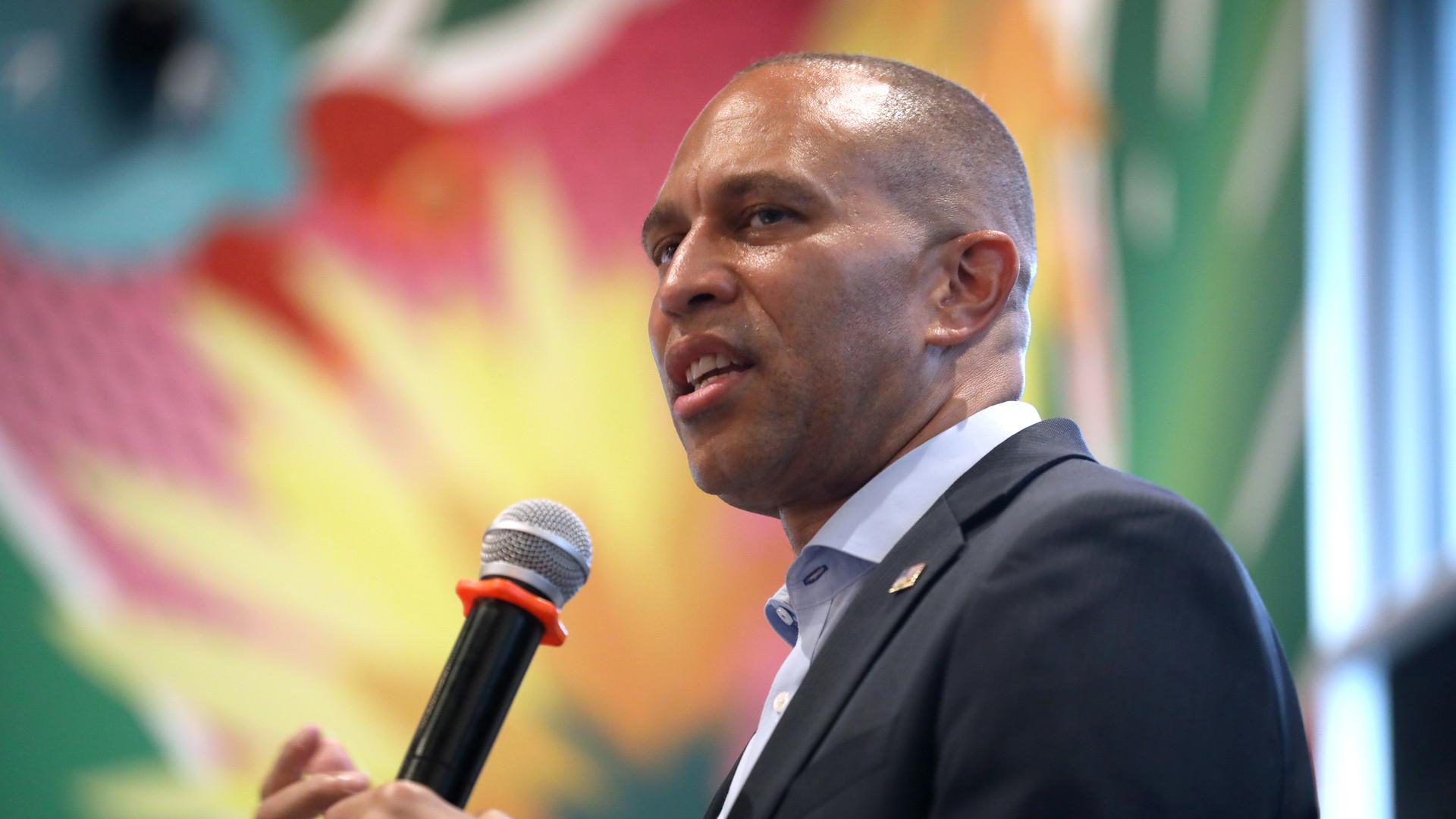
Hakeem Jeffries, the top House Democrat and the likely next speaker, said in a televised interview on Nov. 22 that "we've got to clean up the mess in Washington." He added, "That means the Congress, that means the Supreme Court, and that also means with respect to the administration." A Democratic House can act on some of that pledge on its own, and Court changes still depend on Republican votes in the Senate.
In the Nov. 22 interview, Jeffries said House Democrats will move "very early on in the new Congress" to bar lawmakers from trading stock, and the interview contained no detail on the Court. Asked whether impeachments were an immediate plan for January, he said, "We haven't ruled anything in, and we haven't ruled anything out," in an exchange about accountability that never mentioned a justice. Asked on Aug. 16 about adding justices, he answered, "What I support is dramatic reform," starting with a code of conduct, and said Rep. Jamie Raskin of Maryland, who leads Democrats on the Judiciary panel and is expected to chair it next year, would take the lead on that work.
The Constitution gives the House the sole power to impeach and the Senate the sole power to try, with conviction requiring two-thirds of senators present. The House has impeached only one justice, Samuel Chase, in 1804, and the Senate acquitted him the next year, with the vote on each article far short of two-thirds. Democrats will hold 56 Senate seats in the new Congress, counting two independents who caucus with them, after the Alaska race was called on Nov. 17. Removing a justice would still need at least 11 Republicans even if every member of the Democratic caucus voted to convict, with all senators present.
The justices adopted a code of conduct for themselves in November 2023, and critics say it lacks enforcement. H.R. 3513 by Rep. Hank Johnson of Georgia, with a Senate companion, S. 1814 by Rhode Island Sen. Sheldon Whitehouse, would require a binding code, a process for investigating complaints, disclosure of gifts and broader recusal. H.R. 7692 by New York Rep. Daniel Goldman would let the chief justice create offices of ethics counsel and investigative counsel inside the Court. H.R. 9688 by Raskin, with Rep. Alexandria Ocasio-Cortez among its cosponsors, would bar federal judges from taking gifts worth more than $50 at a time. When Democrats last held both chambers, the House passed H.R. 1 in March 2021, which required a conduct code for the justices, and it never passed the Senate.
Article III protects the justices' pay and ties removal to impeachment, while the Court's staff and security run on annual spending bills. Justice Samuel Alito told a conservative lawyers' dinner on Nov. 12 that Congress can "turn off the lights" at the Court by withholding funds, without mentioning the election. Article III also makes the Court's appellate jurisdiction subject to "such Exceptions" as Congress writes, a power Congress used in 1868 to remove a pending appeal that the Court then dismissed. Scholars disagree on the outer limit, and the Congressional Research Service says Congress cannot breach other constitutional provisions or dictate a case's result.
Term limits by amendment need two-thirds of both chambers and three-fourths of the states, as in H.J.Res. 174 by Rep. Johnny Olszewski of Maryland, which would end any justice's tenure at 18 years. Johnson's H.R. 3544 would set 18 years of active service followed by senior status, a design whose constitutionality is disputed. Expansion needs only a statute, because nothing in the Constitution sets the Court's size, and Congress settled on nine in 1869.
H.R. 8647 by Rep. Al Green of Texas would raise the Court to 13, a number Rep. Jim Clyburn of South Carolina endorsed on Aug. 30 and Jeffries has not endorsed, and it would face a filibuster and a president whose signature is uncertain. On Sept. 2, Reps. Andrew Garbarino and Nick LaLota, both Long Island Republicans, voted yes, and Jeffries voted no, on H.J.Res. 1 by Rep. Andy Biggs of Arizona, an amendment to fix the Court at nine justices that fell short of the two-thirds it needed. LaLota wrote on X that nine seats have been the norm for more than 150 years and that he voted for an amendment preserving that.
On July 22 the House passed the Stop Insider Trading Act, H.R. 7008 by Rep. Bryan Steil of Wisconsin, with every Republican and 13 Democrats voting yes. The bill bars members and their spouses from buying individual stocks and requires advance public notice of sales. Garbarino and LaLota voted yes, and both voted no on the Democratic motion to recommit it. LaLota was an original cosponsor and wrote on X on July 20 that he supports "banning stock trading by Members of Congress." Senate Democrats blocked the bill on Sept. 30, calling its limits too weak and objecting to an attached voter identification rule, and the vote fell short of the 60 needed.
Rep. Robert Garcia of California, the incoming Oversight chairman, has told Republicans to "lawyer up" and on Nov. 18 sent letters asking 12 relatives and allies of President Donald Trump to preserve records, a step House chairs can back with subpoenas. Jeffries called himself "a hard Yes" on the effort to impeach Pete Hegseth, the defense secretary, and on Nov. 10 the House sent the resolution to committee, which ended it. Garbarino and LaLota both voted to refer it, and LaLota said of the effort, "Impeachment has been watered down." In a Nov. 13 post, he urged Democrats to deliver on affordability and said they should not pursue "partisan investigations and frivolous impeachments." No statement from either lawmaker on Jeffries's Nov. 22 interview had surfaced by the afternoon of Nov. 22, and Garbarino has made no statement on the stock-trading, Court or Hegseth votes.
Jeffries has set no timetable for any Court measure in his Nov. 22 pledge. The House can police its own members, open investigations and vote to impeach without waiting on the Senate. Changes to how the Court is governed or funded need Senate votes Democrats will lack without Republican help. He has assigned that work to Raskin, who is expected to take the Judiciary gavel in January, with the code-of-conduct bills filed.
You Might Also Be Interested In

Clayton Warns of More Tech Disruptions as Systems Are Upgraded
Senate Passes 62-33 Permitting Bill to Speed Energy Projects and Make Data Centers Pay for Grid Upgrades
Trump Signs Order Requiring Contractors to Alert White House on Congressional Requests