Gallego Tells Nvidia's Directors They Will End Up Poor or Broke
The warning lands after the president said he personally secured the chief executive's return
Increasingly our government gives the appearance of two rival organized crime syndicates trying to consolidate power and destroy each other's allies and associates. Such a framework is neither in our best interests nor sustainable.
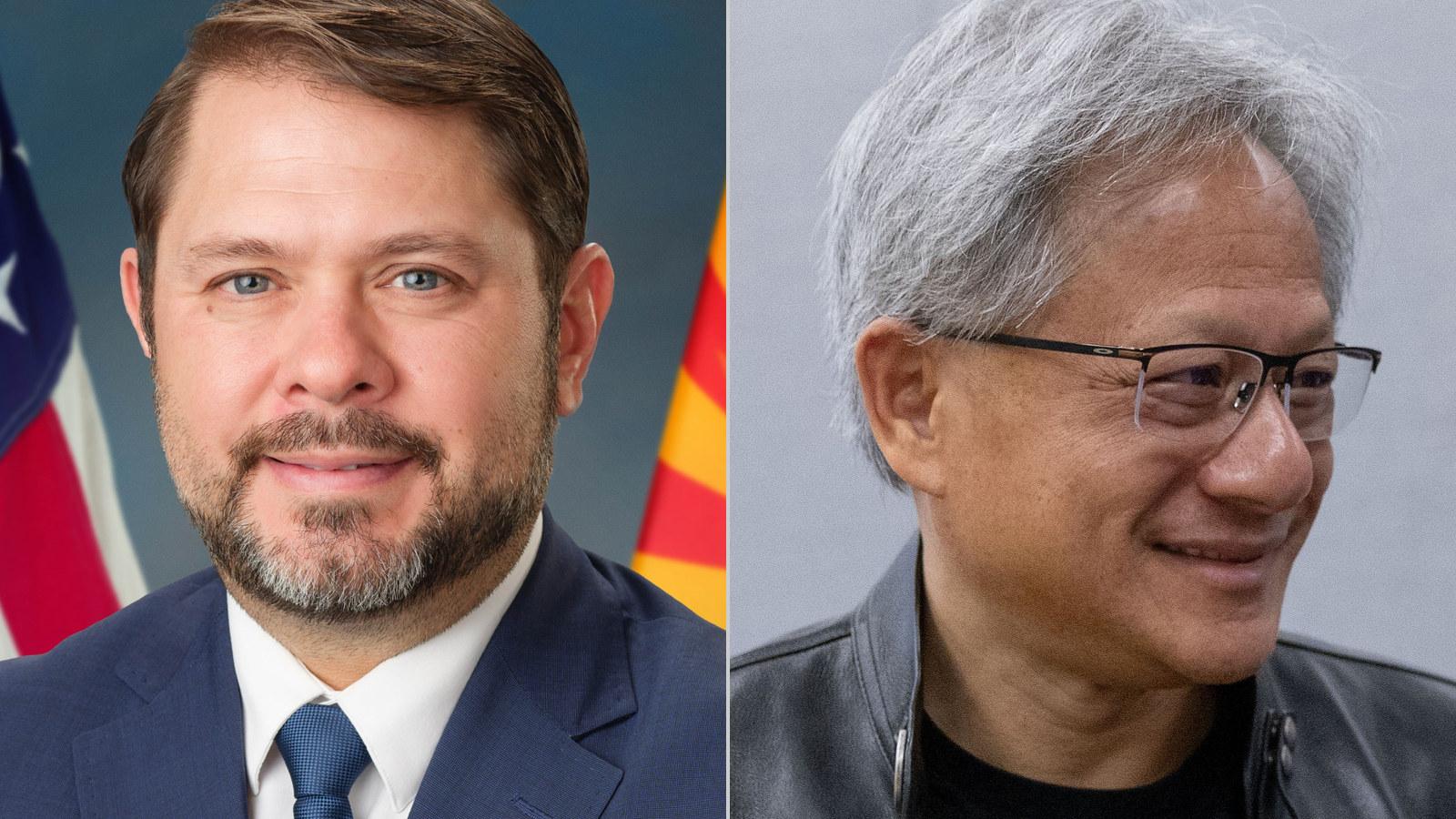
This week Sen. Ruben Gallego of Arizona issued a warning to Nvidia's directors in a television interview and repeated it Tuesday in a press release from his own office. Cooperate with Democrats once they take power, he said, or end up "poor or broke."
The release went out a day after Nvidia's board unanimously restored Jensen Huang as president, chief executive, and a director. Gallego's office presented the remarks as a message to people involved in that decision, including the board. "It's best, right now, for you to come out openly, strike a deal with Congress, specifically next session when we get in power, and protect yourself, protect your family, and protect your future," he said. "Because, again, Donald Trump will be gone. There is not going to be Todd Blanche to cover your ass, and you're going to end up being poor or broke if you don't cooperate."
There is limited information available to the public on the details of what Huang may or may not be guilty of. What did become clear, however, after his resignation, is that the AI race is a national security matter, and Nvidia is the linchpin of the American side of that race. Without Huang, it became clear that Nvidia would unravel from employee departures and deteriorating leadership, and the failure of Nvidia would weaken American AI ambitions. One can debate whether our national security hinging on one man's participation is a healthy dynamic for America, and it is almost certainly not, but that is the state of affairs and the Trump administration made the decision to help get Huang back into his role as CEO of Nvidia. Gallego is now threatening the board members of Nvidia who cooperated with the American government to secure our national security.
Democrats won both the Senate and the House in this month's elections and will control Congress when the new session opens in January. Gallego sits on the Senate Banking Committee, which has already called Huang to testify on Dec. 3. In this view, those remarks are a shakedown of the board's members, telling them that when Trump is gone in two years the Democrats will be coming for them.
Gallego's office has had to answer reports of a Justice Department inquiry into his own campaign spending. A spokesman called the inquiry a political attack and said the department was "turning a blind eye to Trump's unprecedented corruption." Gallego has rejected the spending allegations and faces no criminal charge. In June, the Senate Ethics Committee dismissed a separate complaint against him, writing that it "did not find evidence" of a violation of federal law, Senate rules, or the conduct standards that bind senators. Rival crime syndicates using levers of power to attack each other is the normal course of business, and Gallego suggests that is what the Trump administration is doing.
Gallego's warning on Huang cuts two ways at once, implying that the Trump Justice Department, under Attorney General Todd Blanche, is either failing to do its job or is doing something unlawful, and announcing that Democrats will target a company before they know the facts. Gallego said that "in two years or less" Congress will probably get whistleblowers and "a lot of public information," and will then "figure out exactly what the tick-tock was about when they were actually sending and shipping these chips." By his own account, the threat is being issued now and the evidence is expected later.
The administration has decided Nvidia is too important to American leadership in artificial intelligence, and to the nation's security, for its founder to stay out of the job. Trump said he had been speaking to the board "directly and indirectly." "I convinced them," he said. "I made the deal." The board said that, after hearing from senior U.S. government officials, it was "confident that Mr. Huang's reinstatement poses no national security risk." The board also said a committee of independent directors, formed after reports that Huang had been "the target of a foreign intelligence effort," would carry its inquiry through to a conclusion, and that Huang had pledged to cooperate. Trump said the directors asked for assurance Huang posed no national-security threat, and that the administration "gave them assurances, at least with everything we know."
On Wednesday, Vice President JD Vance said Nvidia's chips are an important part of keeping the United States ahead of China in artificial intelligence. Officials at the Justice Department and in the national security agencies, he said, had assured him Huang was under no investigation. Speaking for himself on a pardon, Vance said, "I don't think he needs a pardon at all."
A sitting senator has now told the directors of a company the administration judges central to those same aims that they should cut a deal now or be ruined later, before the facts are in. If those are the administration's national security goals, whose goals does this warning serve? It would appear in this case that either Gallego has information on Huang that the rest of us are unaware of, or that he is simply trying to weaken his perceived rival syndicate for the benefit of his own, or worse, our adversaries in the AI race. The American people deserve better, and this path is simply not sustainable.
You Might Also Be Interested In
New York Is Turning Away the Growth Data Centers Bring
Giuliani Earned the Medal in the Years His Critics Skip
Mamdani's Sanctuary City Runs on Two Sets of Rules